Giza Pyramid Complex
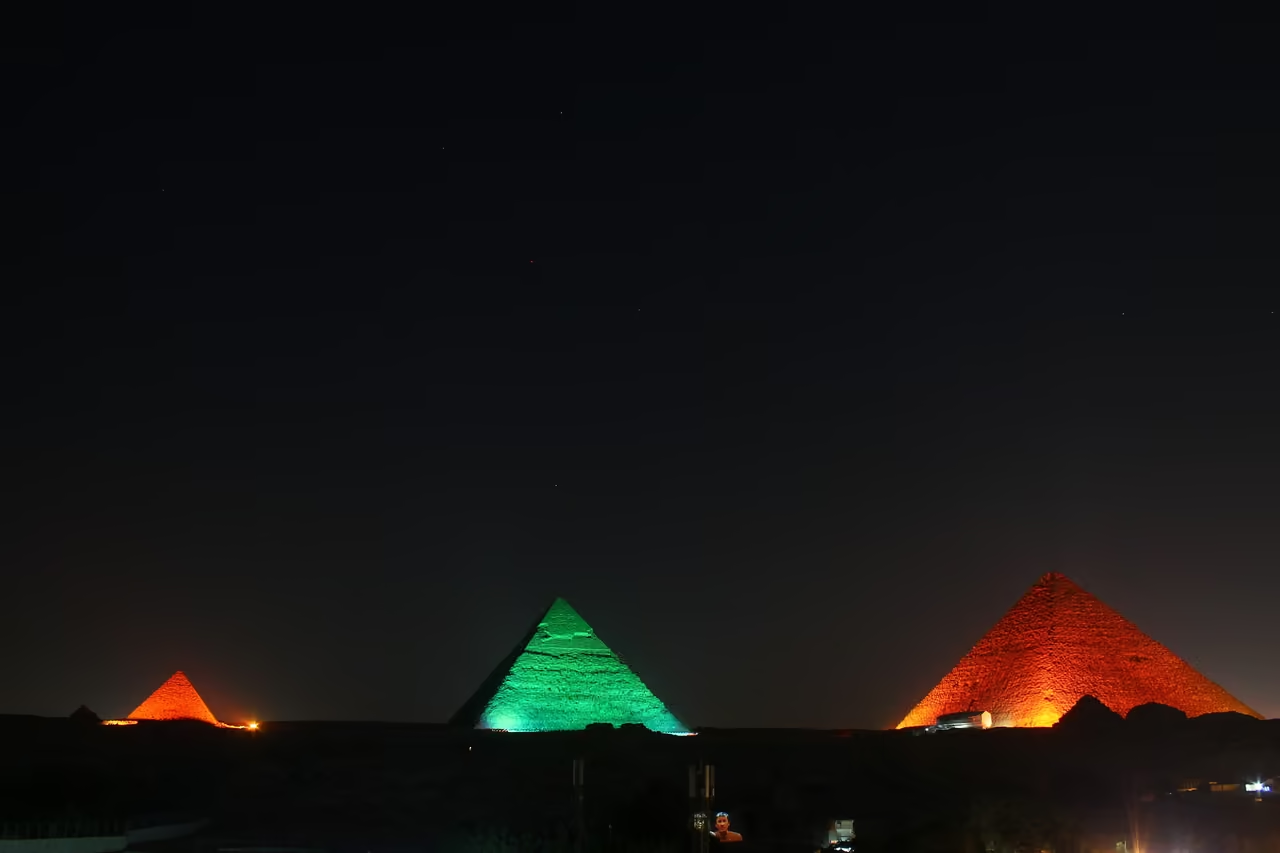
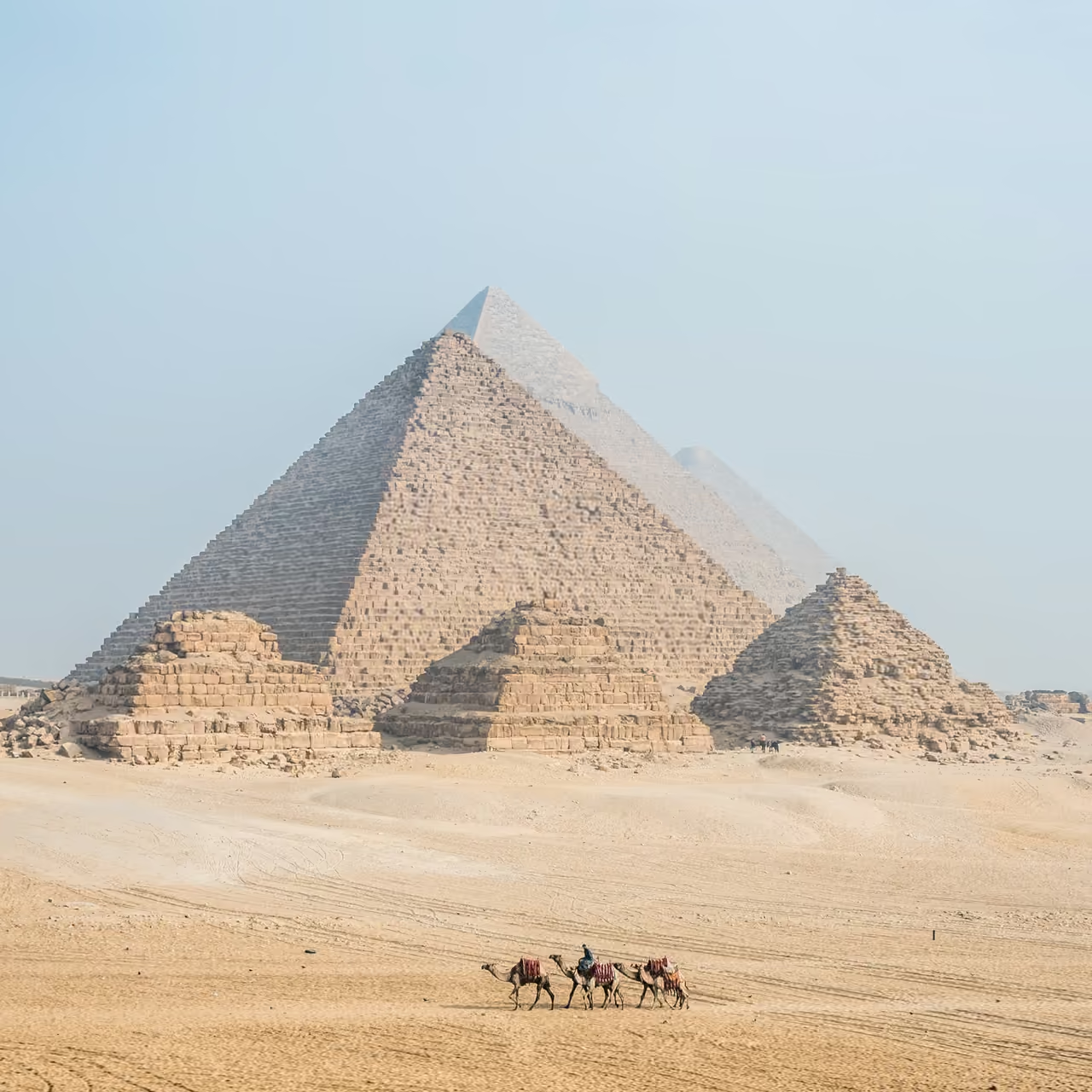
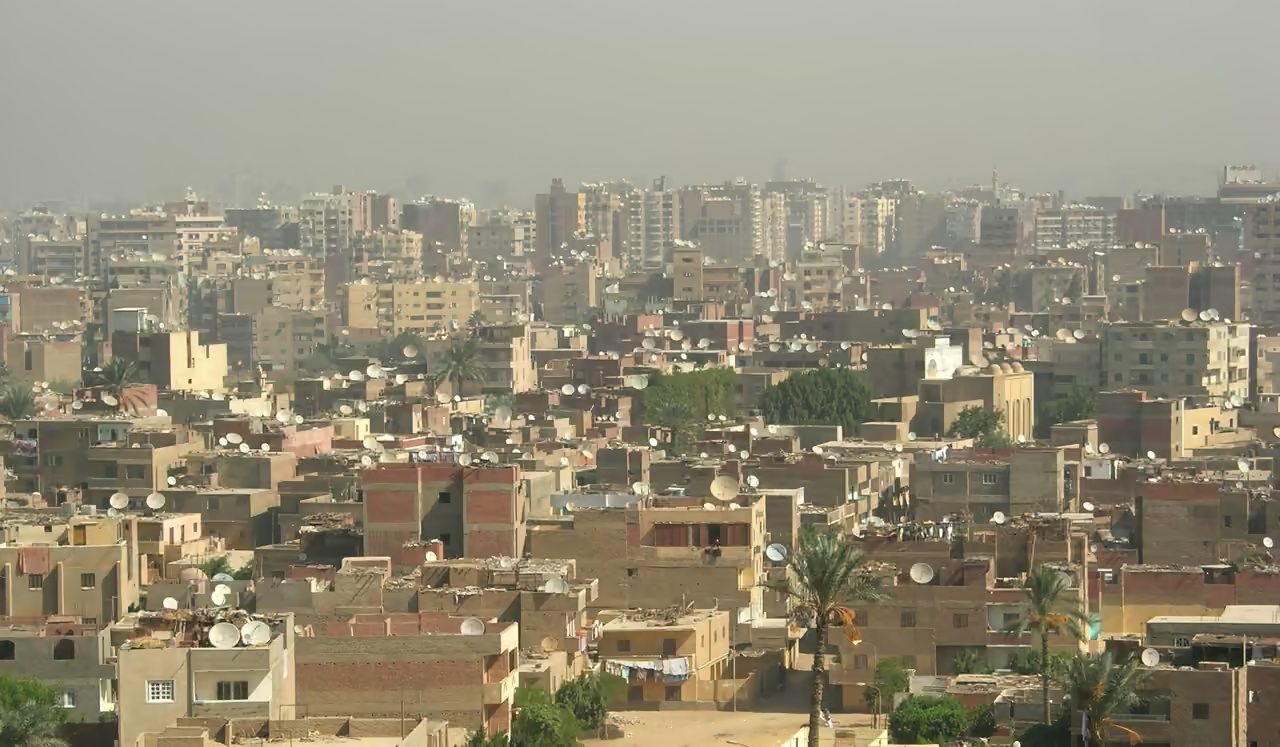
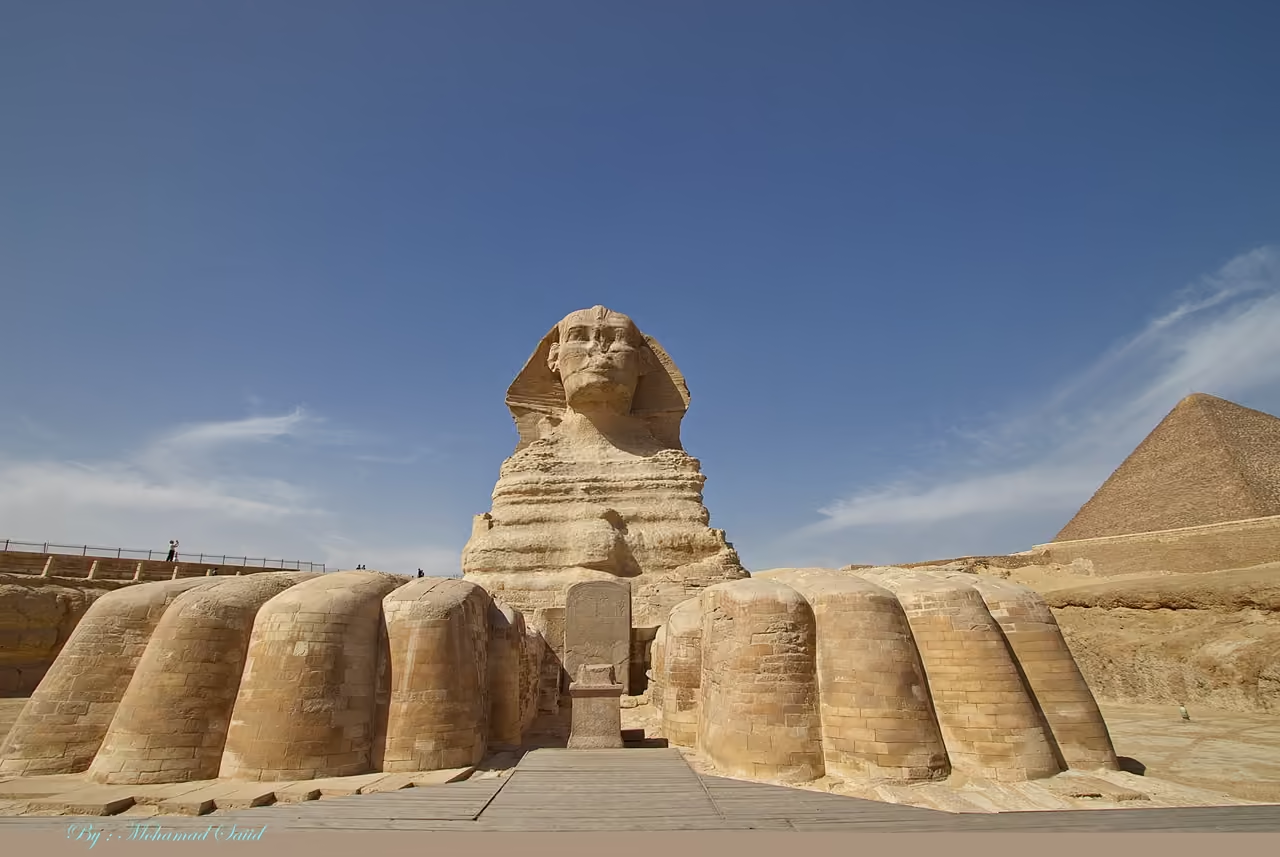
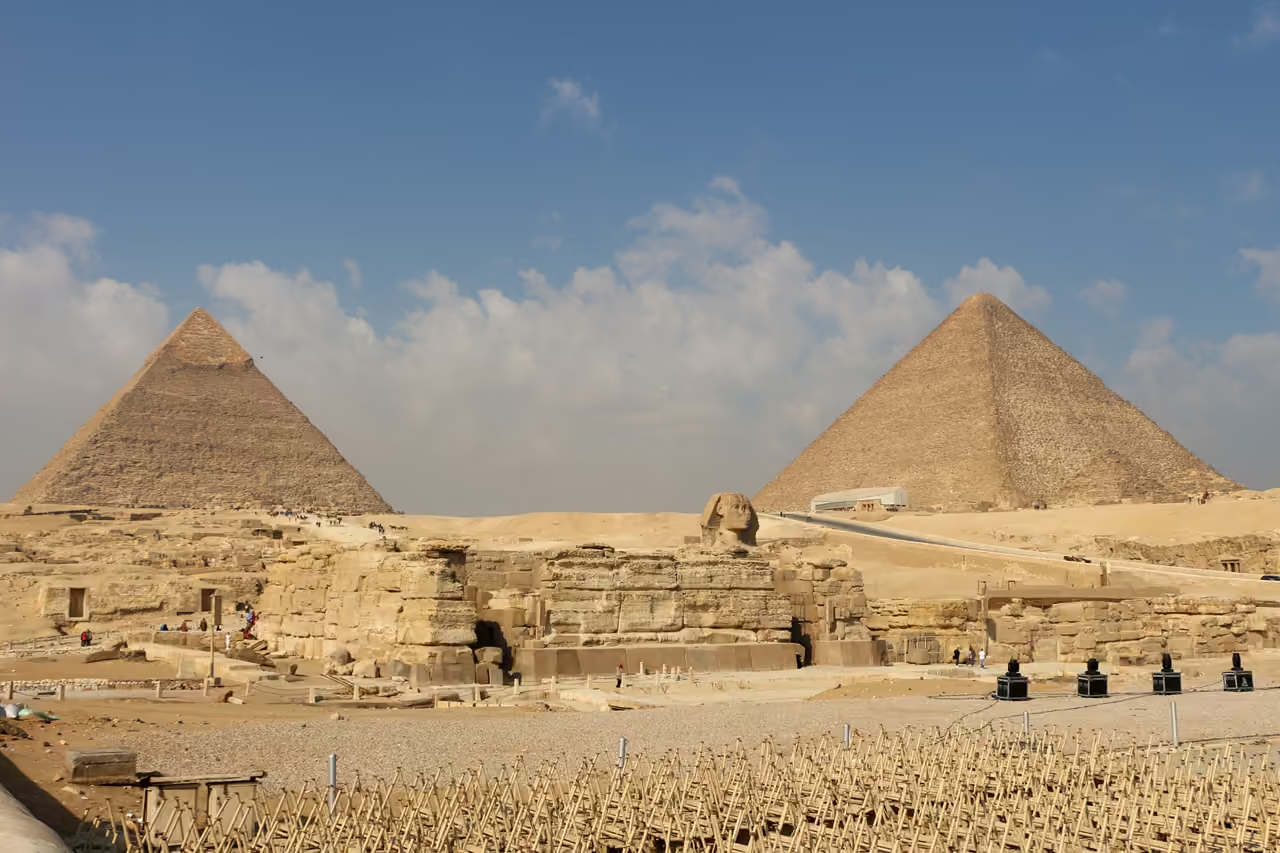
Nine kilometres west of the Nile, the apartment blocks of Nazlet el-Samman stop abruptly at the limestone boundary of the Giza Pyramid Complex. Three royal tombs own the desert skyline. Khufu's Great Pyramid stands as the sole surviving Wonder of the Ancient World, flanked by Khafre's monument perched higher on the bedrock with its smooth white cap intact, and Menkaure's smaller tomb farther southwest. On the eastern flank sits the Great Sphinx, encircled by ordered streets of royal mastabas and ancient boat pits carved into the rock. Electric shuttle buses loop between the desert viewpoints and the 9 Pyramids Lounge, though patience pays off when queues gather outside the cramped doorway leading into Khufu's warm interior corridor. Step back out late in the afternoon as the stone turns honey gold and the hum of Greater Cairo rises straight over the plateau wall.
Videos
History of Giza Pyramid Complex
Fourth Dynasty engineers refused to build on desert sand. Around 2600 BC, royal surveyors mapped flat expanses of solid Mokattam limestone bedrock capable of bearing millions of tonnes without shifting. From those foundations, builders stacked Khufu's Great Pyramid and its neighbours in horizontal tiers, using copper chisels on soft local stone and wearing down 8,000 tonnes of harder granite with abrasive sand and coarse powders. Wooden sledges hauled massive slabs over watered ground while river barges unloaded fine white casing blocks from the Tura quarries across the Nile. Each slanted monument acted as a protective vault and stone ramp built to shelter a pharaoh's vital essence, called the ka, and guide his spirit skyward toward the sun god Ra. Pulling off three royal complexes within a single century demanded an urban machine right beside the construction zone. Mark Lehner's excavations southeast of Khafre's causeway uncovered a planned workers' city erected in bursts over roughly four decades. Inside lay communal sleeping halls, bakeries, breweries, and kitchens turning out bread, beef, and fish alongside an arsenical copper smithy and a medical clinic. Skeletons buried nearby still carry healed workplace fractures. Together, those finds reveal roughly 10,000 to 30,000 rotating citizens and permanent artisans housed inside one of history's earliest planned settlements. Centuries after the Old Kingdom collapsed, drifting dunes threatened to erase the necropolis before New Kingdom kings reclaimed the site as an active religious sanctuary. Thutmose I likely raised a brick chapel beside the Sphinx, Amenhotep II added a temple nearby, and later 21st Dynasty builders reconstructed the Temple of Isis Mistress of the Pyramids right on the plateau. By the Hellenistic age, Greek poet Antipater of Sidon ranked the Great Pyramid at the top of the Seven Wonders of the World. Medieval Cairo, however, treated the monuments as a ready quarry rather than an untouchable relic. Between the fifth and fifteenth centuries, masons pried away nearly all of Khufu's gleaming white Tura casing and stripped Menkaure entirely bare, hauling the stone across the river to raise new city walls and houses. By 1900, amateur digging threatened the remaining cemeteries. Private excavator Montague Ballard tore through the Western Cemetery without keeping records or publishing a single find. Egypt's Antiquities Service stepped in during 1902 under Gaston Maspero, limiting permits strictly to public scholarly institutions. Disciplined fieldwork soon mapped the burial avenues flanking Khufu's tomb, uncovering treasures such as Queen Hetepheres I's chamber in the East Field and the mastaba of court dwarf Seneb in the West Field. Over the past century, Greater Cairo pressed across the Nile floodplain until modern apartment streets met the plateau's edge. Soon the necropolis doubled as a modern national stage, hosting the tournament draws for the 2019 Africa Cup of Nations and the 2021 World Men's Handball Championship before a seventeen million euro overhaul added a visitors' centre and cinema. Behind those modern gates in the West Field, Old Kingdom viziers still rest along quiet limestone avenues laid out four and a half millennia ago.
14 events spanning 4601 years
Fun Facts
14- 01
Ancient builders oriented Giza's colossal stone pyramids to the cardinal compass points within a fifteenth of a degree. That pinpoint accuracy continues to fuel rival astronomical theories linking the monuments either to the three stars of Orion's Belt or to shadow measurements cast by a vertical gnomon rod on the autumn equinox.
- 02
At a 1903 meeting inside the nearby Mena House Hotel, Mary Reisner literally pulled strips of paper out of a hat to divide Giza's unexcavated Western Cemetery among rival Italian, German, and American teams. Italian archaeologist Ernesto Schiaparelli, German scholar Ludwig Borchardt, and American George Reisner also split rights to the three main pyramids, though the Italians gave up their cemetery strip to the Americans in 1905 to chase papyrus discoveries elsewhere.
- 03
Centuries of archaeological study have not stopped the plateau from turning into a dramatic live venue. American rock pioneers the Grateful Dead performed beneath the pyramids in 1978 for their live album Rocking the Cradle, and Colombian singer Shakira drew roughly 100,000 concertgoers to Giza in 2007.
- 04
Confused by the colossal geometry rising above the desert, many medieval visitors convinced themselves the pyramids were never royal tombs at all. Travelling from Spain in 1436, Pedro Tafur documented the popular theory that Giza's monuments were actually the biblical Granaries of Joseph built to stockpile grain against famine.
- 05
Discovered at Wadi el-Jarf in 2013, the world's oldest surviving papyrus diary records the daily shipping schedules of an official named Inspector Merer during the closing stages of the Great Pyramid. His logbooks track crews hauling gleaming white limestone blocks from the Tura quarries across waterways straight to the Giza construction docks.
- 06
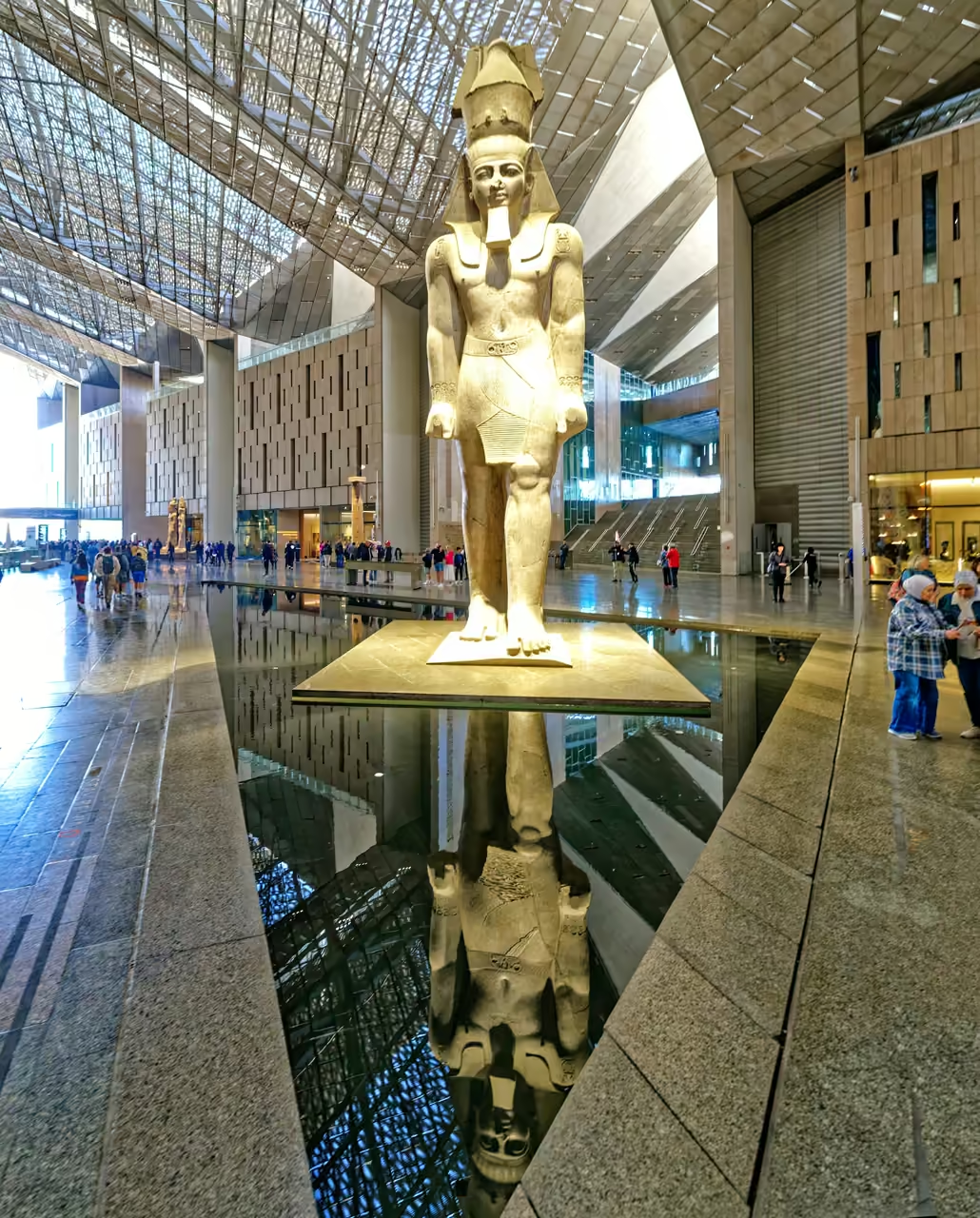
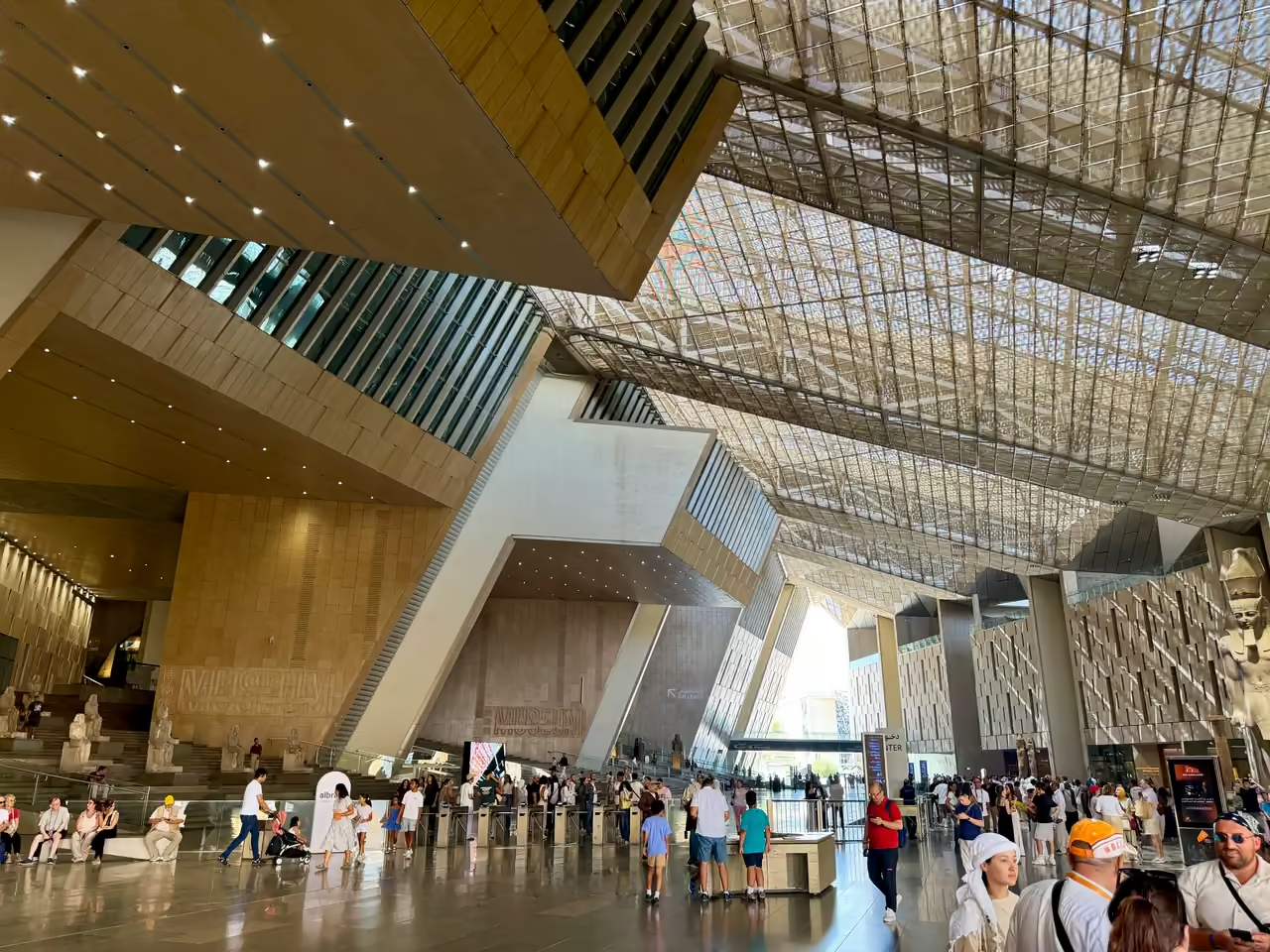
Excavators opening sealed stone pits on the south flank of Khufu's pyramid found two complete ancient vessels waiting in the dark. After decades on display at an adjacent museum, the restored cedar Khufu ship rolled out across Giza aboard a specially tested transport vehicle in 2021 to take up residence at the Grand Egyptian Museum.
- 07
Hidden near Khafre's causeway, the narrow Osiris Shaft plunges downward through three distinct underground tomb chambers before ending in a permanently flooded cavern. Mentioned by Egyptian archaeologist Selim Hassan in the 1930s and thoroughly explored by Zahi Hawass's team in 1999, the subterranean monument opened to tourists for the first time in November 2017.
- 08
Modern municipal trenches for the Greater Cairo Wastewater Project unexpectedly turned up remains of a vanished Maadi culture settlement right beside the pyramids. Paired with four prehistoric jars discovered at the foot of Khufu's tomb, radiocarbon studies suggest people settled the Giza plateau between roughly 3800 and 3400 BC, a full millennium before the first pharaohs stacked stone there.
- 09
More than two thousand years after the Old Kingdom pyramids were sealed, elites of Egypt's Late Period still sought burial beside Khafre's causeway and the Sphinx. Among those latecomers were army commander Ahmose and his mother Queen Nakhtubasterau, wife of Pharaoh Amasis II, who chose tombs anchored in the shadow of Egypt's golden age.
- 10
Pharaonic rivals rarely hesitated to rewrite history on stone, and Giza preserves one of the cheekiest examples. Centuries after the young pharaoh Tutankhamun built a royal resthouse near the monuments, Nineteenth Dynasty ruler Ramesses II simply claimed the pavilion as his own and raised a new stela in the adjacent Sphinx chapel.
- 11
Standing near Menkaure's valley temple in the Central Field, the tomb of Queen Khentkaus I forms a remarkable royal complex all on its own. Alongside her pyramid, archaeologists traced an individual boat pit, a valley temple, and an attached pyramid town built specifically to sustain her funerary cult.
- 12
Unlike Khafre's and Menkaure's monumental valley temples out on the desert edge, Khufu's valley temple remains buried beneath the modern neighbourhood of Nazlet el-Samman. Although much of its ancient causeway vanished beneath expanding houses, patches of diabase paving and limestone walls confirm the unexcavated gateway still lies right underfoot.
- 13
Visiting Giza around 450 BC, Greek historian Herodotus was told by priests that the Great Pyramid required 400,000 men labouring in shifts of 100,000 over twenty years, sparking millennia of enslaved army myths. Instead, mudbrick workers' tombs uncovered in 1990 and 2009 revealed that paid Egyptian labourers were buried honourably alongside their kings with rations of bread and beer for the afterlife.
- 14
When drifting desert sand buried the Great Sphinx up to its shoulders during the New Kingdom, young Prince Thutmose IV claimed the statue spoke to him in a dream and promised him Egypt's crown if he dug it free. Once crowned pharaoh, he placed the inscribed Dream Stele directly between the Sphinx's front paws to publicise his side of the bargain.
FULL PLACE DETAILS
Updated
FULL PLACE DETAILS
UpdatedOVERVIEW & STATS
- Elevation
- 27 m
ARCHITECTURE & HERITAGE
- Heritage Status
- Part Of Unesco World Heritage Site
WEB & AMENITIES
Giza Pyramid Complex Map & Neighborhood Explorer
This interactive map is centered on Giza Pyramid Complex. Zoom in and move the map around to automatically discover Wikipedia photos and summaries of other nearby sights, monuments, and historical points of interest and stories in real-time!
Giza Pyramid Complex FAQ
The complex sits on the edge of the Western Desert in the city of Giza, roughly 13 kilometres southwest of Downtown Cairo and 9 kilometres west of the Nile. Greater Cairo's suburbs extend right up to the perimeter wall, making it a straightforward urban trip rather than a remote desert expedition.
The Great Pyramid of Khufu is the tallest and largest structure on the plateau, even though Khafre's neighbouring pyramid often appears higher from the ground. Khafre's architects chose slightly elevated bedrock and a steeper angle of inclination, creating a visual illusion aided by the white limestone casing still capping its summit.
Access is available inside the royal monuments as well as the three levels of the Osiris Shaft opened to visitors in November 2017, alongside open walks around the Great Sphinx and the surrounding royal mastaba cemeteries. Inside the pyramids, passages are tight, sloped, and warm, so sturdy flat shoes and comfortable clothing help considerably.
Modern upgrades brought electric shuttle buses looping across the sprawling plateau alongside a visitors' centre, updated signage, public toilets, food trucks, a cinema, and wireless internet. Visitors looking for a relaxed meal facing the monuments can also stop at the 9 Pyramids Lounge, the first full restaurant opened directly inside the archaeological complex.
Archaeological finds since 1990 have dismantled that longstanding myth. Excavations of nearby mudbrick worker cemeteries and the planned settlement southeast of Khafre's pyramid show that tens of thousands of rotating Egyptian labourers and permanent skilled craftsmen built the monuments, receiving bread, beef, fish, beer, medical care, and proper burials.
Although two intact ancient ships were unearthed south of the Great Pyramid, the restored cedar Khufu ship formerly displayed inside the Giza Solar Boat Museum was moved in August 2021 to the nearby Grand Egyptian Museum. The excavated stone boat pits themselves remain visible in the bedrock beside Khufu's and Khafre's monuments.
A typical visit takes about 4 hours. We recommend planning your schedule accordingly to make the most of your time there.
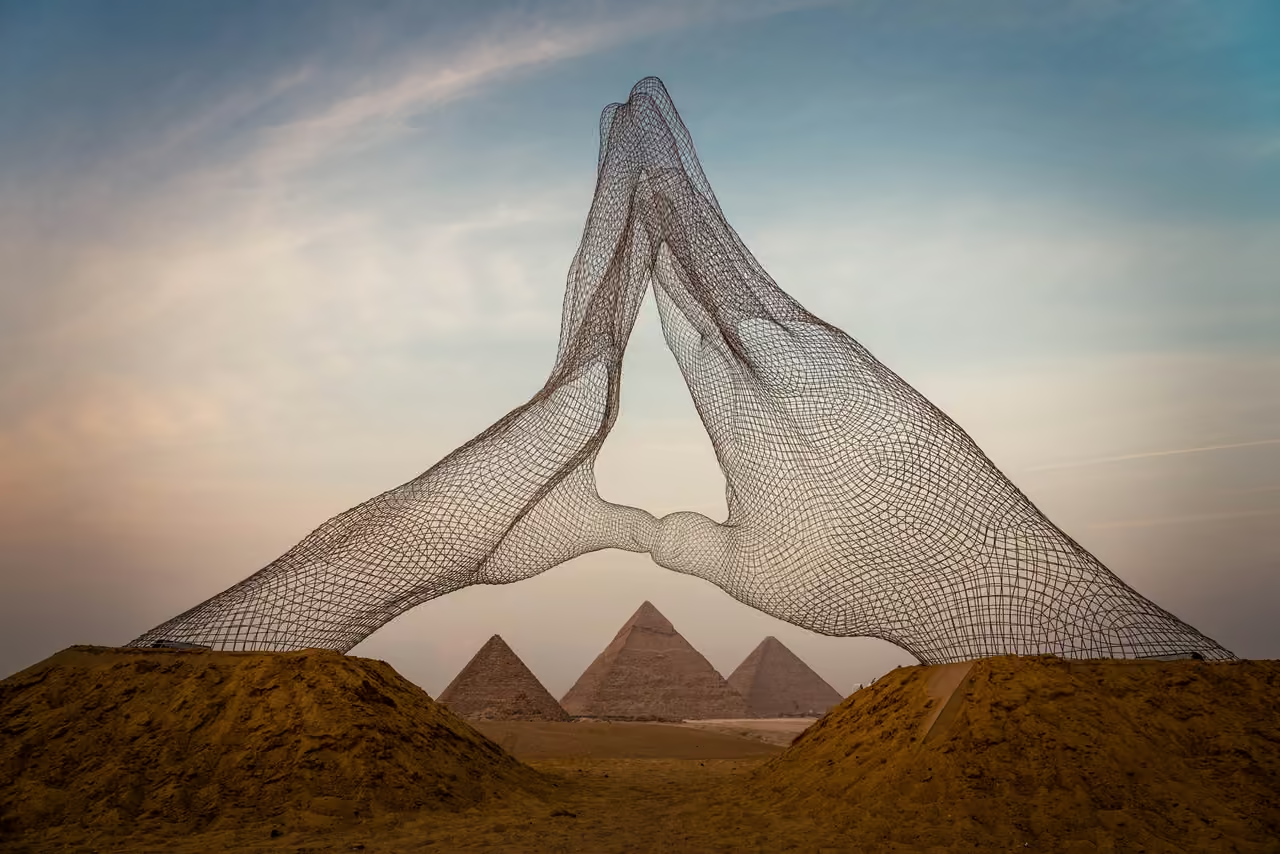
The closest place to visit near Giza Pyramid Complex is Forever Is Now Art Exhibition, around 105 m away. Other things to do near Giza Pyramid Complex include Pyramid of Khafre (174 m), Great Pyramid of Giza (388 m) and Western Mastaba Cemetery (460 m). All of these are within roughly 460 m of Giza Pyramid Complex, close enough to walk.
Giza Pyramid Complex holds the following heritage designation: Part Of Unesco World Heritage Site.
While we strive to keep this information accurate and up to date, we recommend verifying any details independently before making decisions based on them.
Places near Giza Pyramid Complex
Make the most of your trip. Check out these top-rated spots located nearby.
 105m
Forever Is Now Art Exhibition
Mounted each autumn directly across the sand beside the pyramids, this annual contemporary sculpture exhibition sets large-scale installations in dialogue with Fourth Dynasty stone. Egyptian and international artists position mirrored portals, woven monoliths, and kinetic steel frames across the desert floor to catch shifting sunlight from sunrise to late afternoon. General plateau admission grants access, allowing regular visitors to wander straight among works ordinarily limited to global biennales.
festival view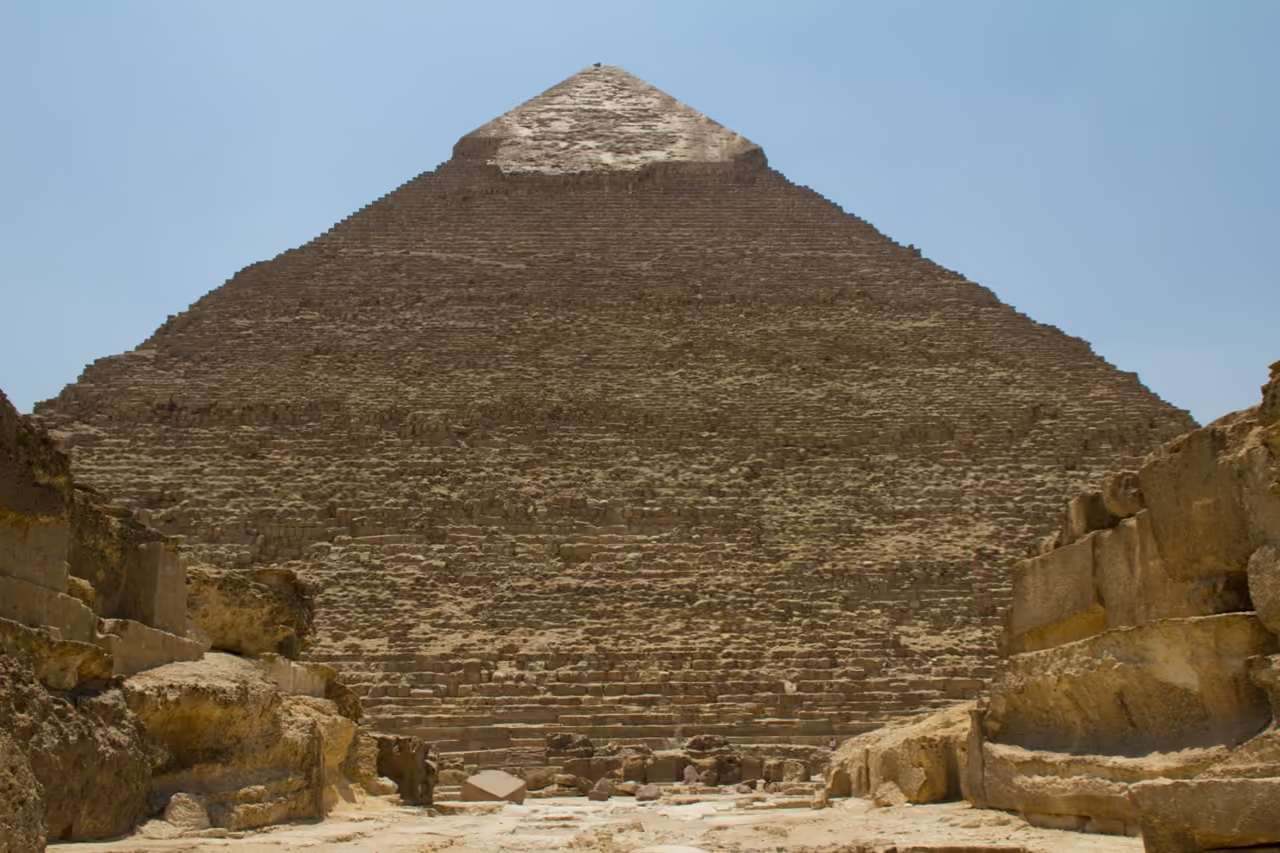 174m
Pyramid of Khafre
Most first-time arrivals mistake Khafre's monument for the tallest pyramid on the plateau, an optical illusion pulled off by Fourth Dynasty surveyors who placed its base on bedrock ten metres higher than Khufu's foundation. Standing 136 metres high, it is the only Giza giant that still wears a dramatic cap of smooth white Tura limestone casing around its upper courses. Access into its steep northern passages alternates annually with Menkaure, offering a quieter interior climb.
architecture view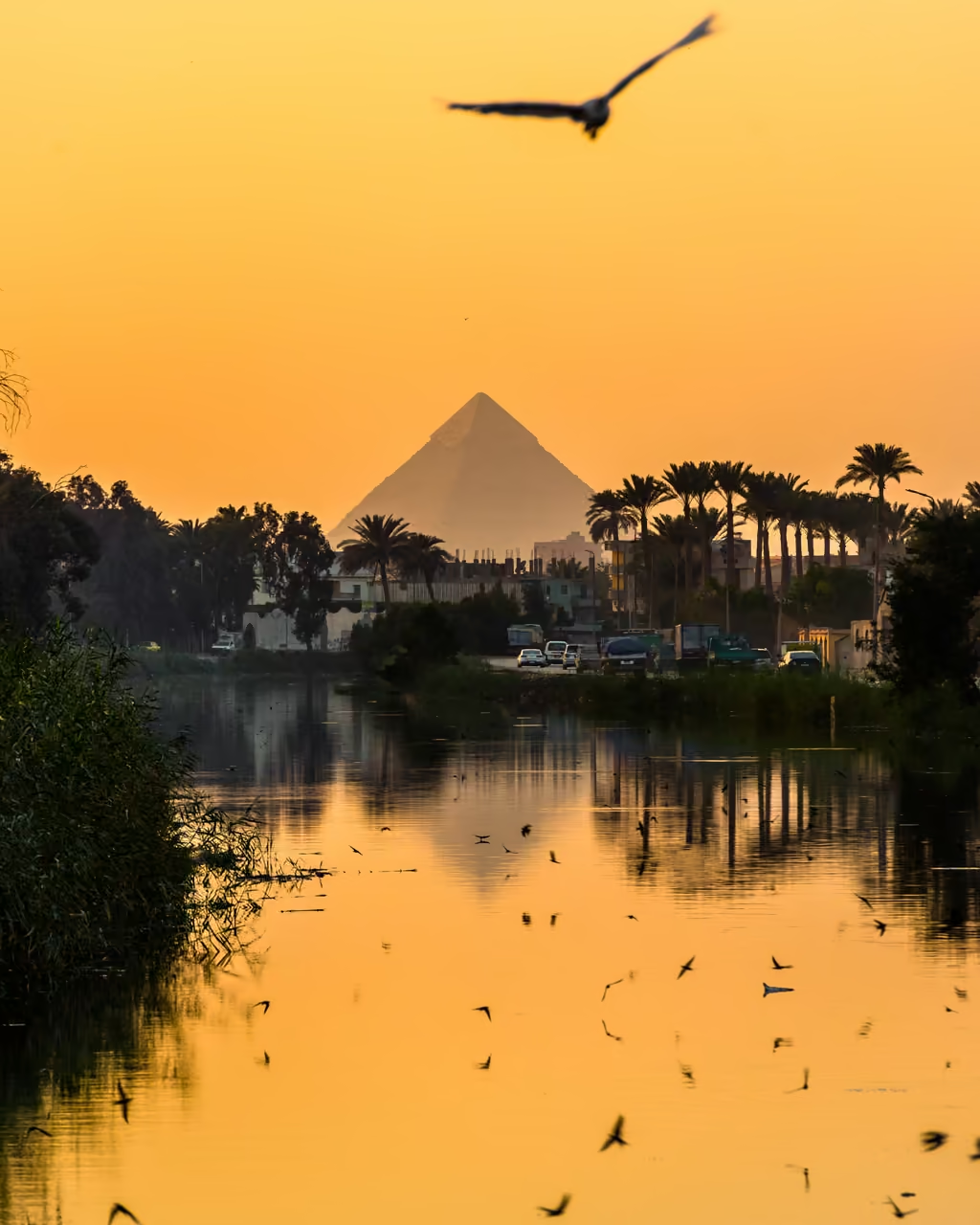 388m
Great Pyramid of Giza
Nothing on the busy streets of Giza prepares you for the moment modern apartment blocks suddenly stop and Pharaoh Khufu's limestone mountain shoulders straight out of the plateau. Raised around 2600 BC and still standing 138.5 metres tall, this structure remains the only intact member of the Seven Wonders of the Ancient World, though its gleaming white outer shell is gone, exposing rough yellow masonry like desert stairs. Step inside if tight spaces do not rattle you. Ducking along the warm, low ceiling of the Robbers' Tunnel takes patience before the stonework abruptly splits upward into the Grand Gallery, where corbelled limestone walls climb nearly nine metres above your head on the ascent to Khufu's empty granite sarcophagus in the King's Chamber. Back out in the daylight, walk the eastern flank past the black basalt slabs of the ruined mortuary temple and the three stepped Queens' Pyramids sitting right alongside. Look down along the northern base and rest your palm against a few surviving smooth white casing stones still wedged tightly where Khufu's masons set them.
attraction view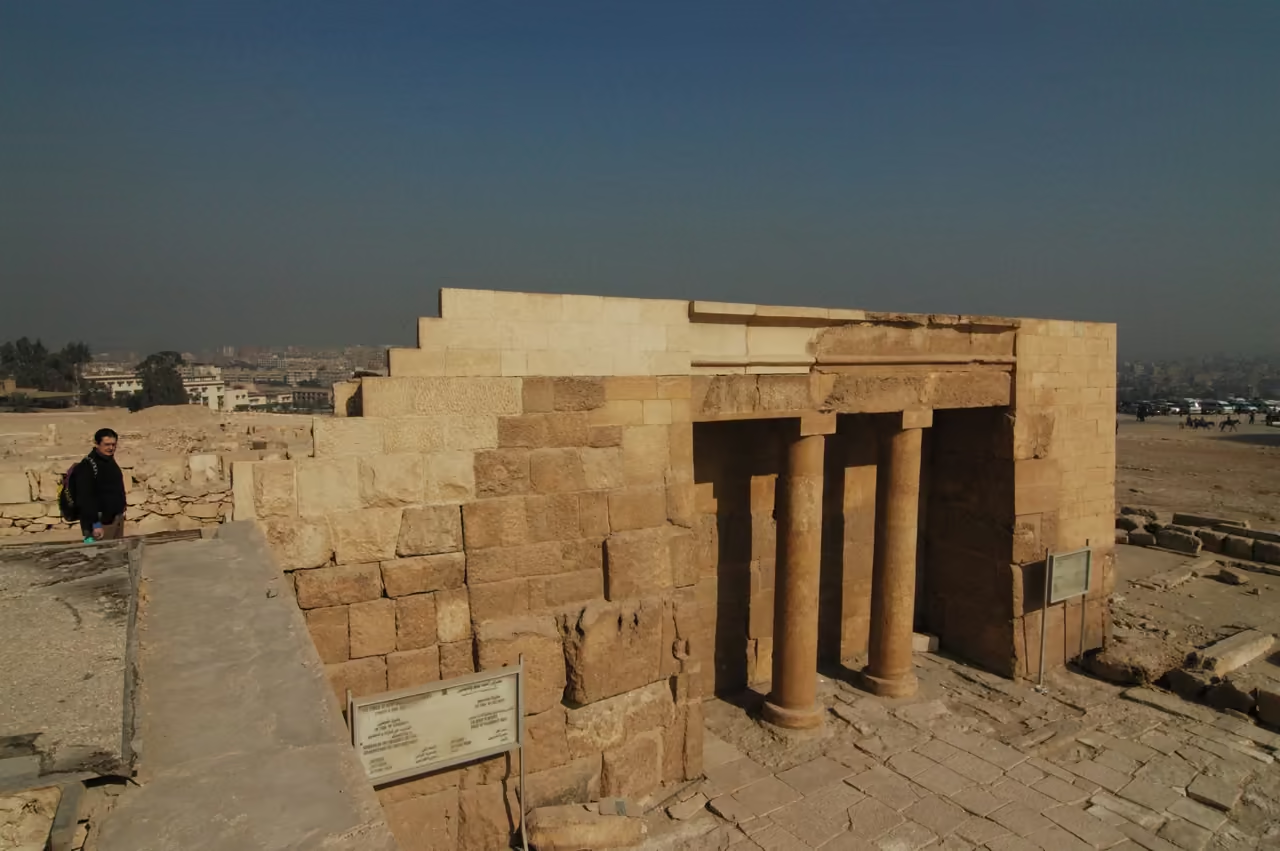 460m
Western Mastaba Cemetery
Laid out across neat street-like rows immediately west of the Great Pyramid, hundreds of flat-topped rectangular limestone tombs preserve the burial quarter of Fourth Dynasty princes, royal architects, and court priests. Stepping into open mastaba chapels reveals finely carved false doors, crisp relief carvings of harvest scenes, and solid bench proportions that shaped early pyramid geometry in total quiet.
architecture view
Featured on These Itineraries
1 Day in Giza: Pyramids, Tutankhamun, and Sphinx Dusk
Short on time yet determined to capture Giza's greatest landmarks cleanly in a single day? Hit the Giza Pyramid Complex right as gates unlock at dawn, cross the plateau to the Western Panorama ridge before heat builds, spend your afternoon inside the air-conditioned Grand Egyptian Museum, and wrap up over mint tea above Nazlet El-Semman as night illuminates the Sphinx.
view itinerary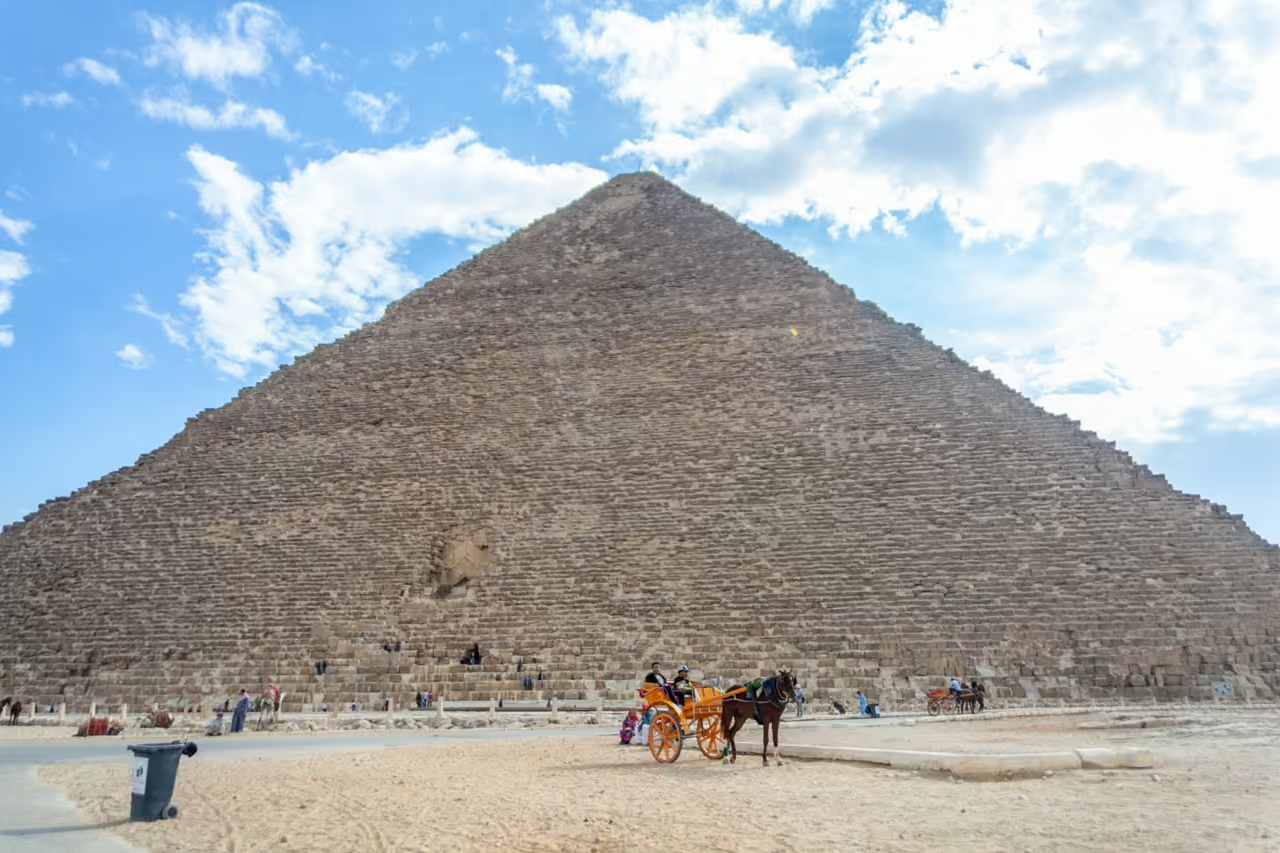
3 Days in Giza: Royal Stone, Artisans, and Nile Nights
Three balanced days let you uncover Giza well past its headline postcard. Dedicate your first morning to deep pyramid exploration and sunset frames, devote day two to the Grand Egyptian Museum, Sahara horseback trails, and Harrania tapestry studios, and spend day three savouring Dokki gardens, Impressionist art palaces, car-free Dahab Island farms, and Agouza riverfront nights.
view itinerary