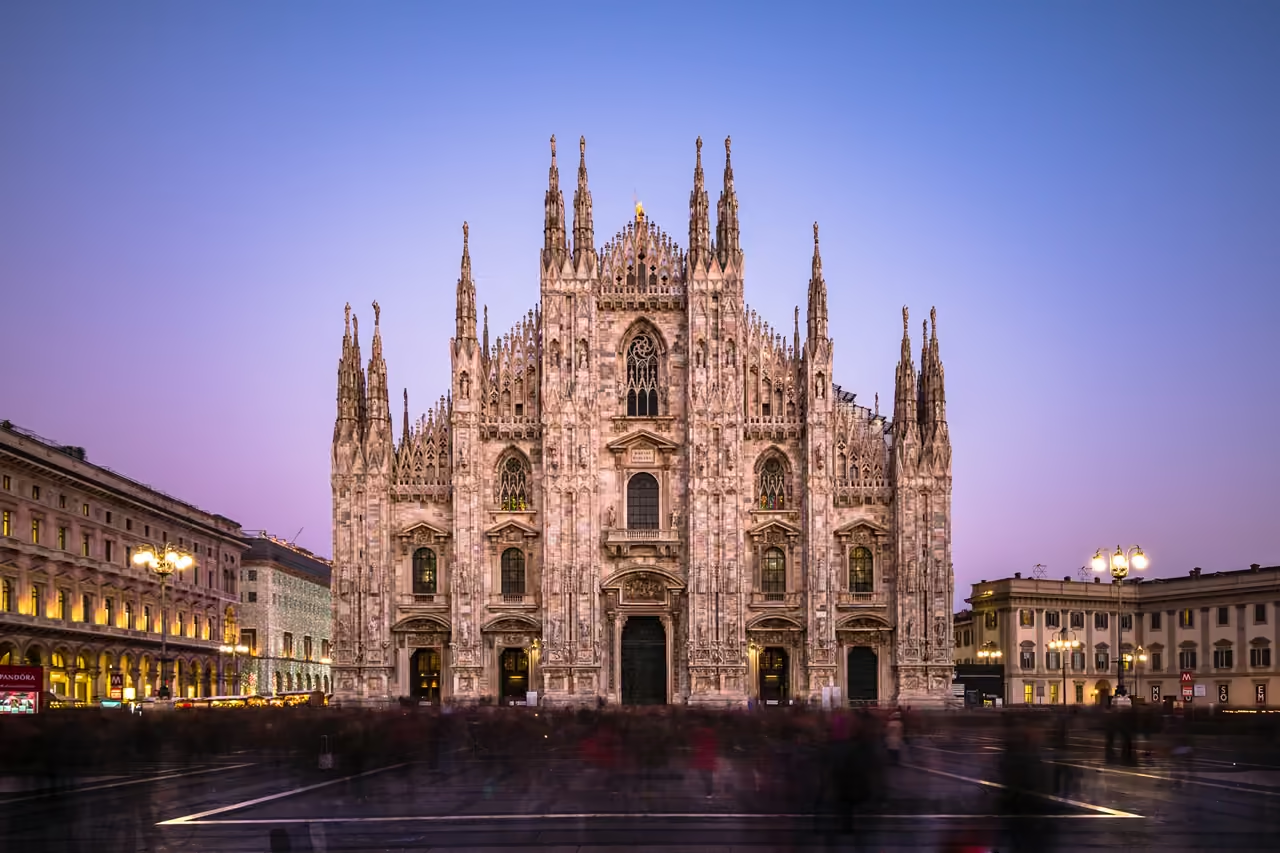
Milan Cathedral
Clad in pinkish white Candoglia marble and bristling with 135 spires, the Duomo is the largest church in Italy, with only Saint Peter's, in Vatican City, bigger. Inside, fifty two pillars hold up a dim, silvery hush, and the light that filters in passes through stained glass made between the 1470s and the 1950s. Among the saints and soldiers carved in stone, a bronze mercenary captain known as the Medeghino hides a lame leg beneath his cloak. Below the floor, a staircase leads to the remains of a fourth century baptistery, and up top a lift delivers visitors to marble roof terraces where pinnacles and statues sit within arm's reach. In November, fifty six giant Baroque canvases telling the life of San Carlo Borromeo are hung inside for his feast. Above everything, 108.5 metres from the ground, the gilded copper Madonnina glints over the piazza.
Videos
History of Milan Cathedral
The story begins with a collapse. In 1386 the bell tower of Milan's old cathedral fell, and Archbishop Antonio da Saluzzo, backed by the townspeople, took the chance to pull down two ageing churches, the winter cathedral of Santa Maria Maggiore and the summer cathedral of Santa Tecla, and replace them with a single building on a far grander scale. Politics sat underneath the piety. The ruler Gian Galeazzo Visconti had recently overthrown his own uncle and then chose to live at Pavia rather than Milan, and a colossal new cathedral was a way for the Milanese to remind him whose city this was. The plan began as a modest Lombard Gothic church in brick. Within a year Gian Galeazzo had taken charge and raised the stakes: the walls would be Candoglia marble from a quarry he handed over to the project, in a style borrowed from the latest German and Bohemian fashions. Every block bound for the site was stamped with the letters AUF, short for 'for the use of the works', which excused it from road tolls. Architects were summoned from France and Germany, but the Lombard masons resented the outsiders, and most of them left within a short time, so the design lurched through one revision after another. Worried that the walls might not stand, the overseers asked the mathematician and astronomer Gabriele Stornaloco in 1391 to work out the building's cross section by geometry. The result was a Gothic cathedral with a split personality, soaring yet broad, with carved capitals crowning its pillars where northern cathedrals would have let the ribs run straight upward. The duke and his builders fell out. Gian Galeazzo wanted the cathedral to hold a dynastic burial place for the Visconti, with his father's tomb at its centre, and both the works committee and the citizens, proud of their independence, dug in against the idea. He gave way and started a separate project for his family at Pavia, the Certosa, which then drew off several of the Duomo's senior craftsmen. By October 1418 the east end was ready, and Pope Martin V consecrated the high altar in a ceremony so crowded that chroniclers claimed 80,000 to 100,000 people, which would have been roughly the whole city. The late sixteenth century brought Archbishop Carlo Borromeo, who drove the work forward and had Pellegrino Tibaldi remodel the sanctuary in line with the Council of Trent; it was reconsecrated in 1577. During the plague of 1576 Borromeo walked through the streets carrying a wooden crucifix, which now rests in an altar in the left aisle. The façade turned into a centuries long argument. Tibaldi drew one in 1580, Baroque architects such as Richini and Carlo Buzzi built the portals, and Bernini and Vanvitelli were both called in as consultants, while designs swung between Roman Baroque and Gothic. In 1805 Napoleon, determined to have a finished cathedral for his coronation as King of Italy, ordered the front completed, and it was closed in Gothic dress by 1813, with the following decades filling up with spires and statues. A competition in 1888 to rebuild the whole front in a French Gothic manner was won by the young Giuseppe Brentano, then stalled after his early death and public fury as the Baroque portals began to be dismantled. Bronze doors arrived across the twentieth century, the last in 1965. The twentieth century also brought damage. In the Second World War the Madonnina was draped in rags so its fresh gilding would not guide Allied bombers, and the windows were taken out and replaced with rolls of canvas; the cathedral was still hit by the raids on the city. Slower trouble followed. By the 1960s traffic vibration and a falling water table had strained the central piers, and chunks of marble were dropping into the aisles. In 1969 the surrounding streets were closed to cars and metro trains were slowed beneath the piazza, and a restoration from 1981 to 1986 reinforced the pillars in time for the sixth centenary. The cathedral did not always stand in the open. Medieval Milan pressed right up against its walls, and only the piazza laid out by Giuseppe Mengoni between 1865 and 1873 gave the marble front its stage. Upkeep has never stopped. The Veneranda Fabbrica, the body set up to build the cathedral, still owns the Candoglia quarry and still employs stonemasons, who set fresh pink marble among pieces weathered by centuries.
16 events spanning 600 years
Fun Facts
15- 01
A brass strip set into the floor near the entrance is a sundial. At solar noon a ray of light enters a hole in the south wall nearly 24 metres up and lands on the strip, beside marble slabs marking the signs of the zodiac, and the marble arch above the hole was left out so it never falls into shadow.
- 02
A wealthy patron named Marco Carelli gave 35,000 ducats at the end of the fourteenth century to speed up the building. The Carelli spire, the oldest on the cathedral, still stands near the terrace lift, topped by a copy of a statue of Gian Galeazzo Visconti.
- 03
About four metres below the piazza lie the remains of the baptistery of San Giovanni alle Fonti, where Saint Ambrose baptised the future Saint Augustine on Easter night in 387. Its octagonal font is the oldest documented example.
- 04
Archbishop Carlo Borromeo had the great Compedo door in the north transept closed up in the sixteenth century. Shoppers from the nearby Verziere market had been using it, and the opposite door on the south side, as a shortcut straight through the cathedral.
- 05
Giuseppe Brentano's unbuilt Gothic façade design is still on view in the right aisle, recorded on a plaque, as a reminder of the front that Milan nearly got in the 1880s.
- 06
Hanging high above the main altar is a nail said to come from the True Cross, found by Saint Helena according to tradition and used as a bit for Emperor Constantine's horse. A red light marks its niche, and the archbishop brings it down on a seventeenth century mechanised lift called the nivola, to be shown on 3 May and carried in procession on 14 September.
- 07
In the crypt, Saint Charles Borromeo lies in pontifical dress inside a silver and rock crystal casket donated by King Philip IV of Spain. His cross of tourmaline and diamonds was a gift from Maria Theresa of Austria, and the silver mask on his face was modelled on the wax mask taken after his death.
- 08
Johann Christian Bach, son of Johann Sebastian, appears on the list of the cathedral's organists. The organs today have about 15,800 pipes and rank among the largest in the world.
- 09
Marco d'Agrate's statue of Saint Bartholomew, carved in 1562, shows the apostle wearing his own flayed skin draped over his shoulders like a stole. The base carries a cheeky Latin boast that Marco of Agrate, rather than the ancient Greek master Praxiteles, shaped it.
- 10
Milanese have a saying, 'Longh come la fabbrica del Domm', meaning something that never ends, because the cathedral's workshop has never stopped repairing and replacing.
- 11
Some scholars argue that the neoclassical statue of the New Law by Camillo Pacetti, on the balustrade of the central façade window, was among the sources of inspiration for New York's Statue of Liberty.
- 12
The Annunciation panel on the central bronze door still carries damage from an air raid in 1943.
- 13
The bronze Door of the Edict of Constantine was begun in 1937 by the sculptor Arrigo Minerbi, who was removed from the job under the racial laws because he came from a Jewish family. It was only inaugurated after the war, in 1948.
- 14
The lantern tower over the crossing drew the biggest names of the Renaissance, with Leonardo da Vinci consulted in 1487 and 1488 and Bramante in 1490. It was Giovanni Antonio Amadeo who built the 68 metre structure.
- 15
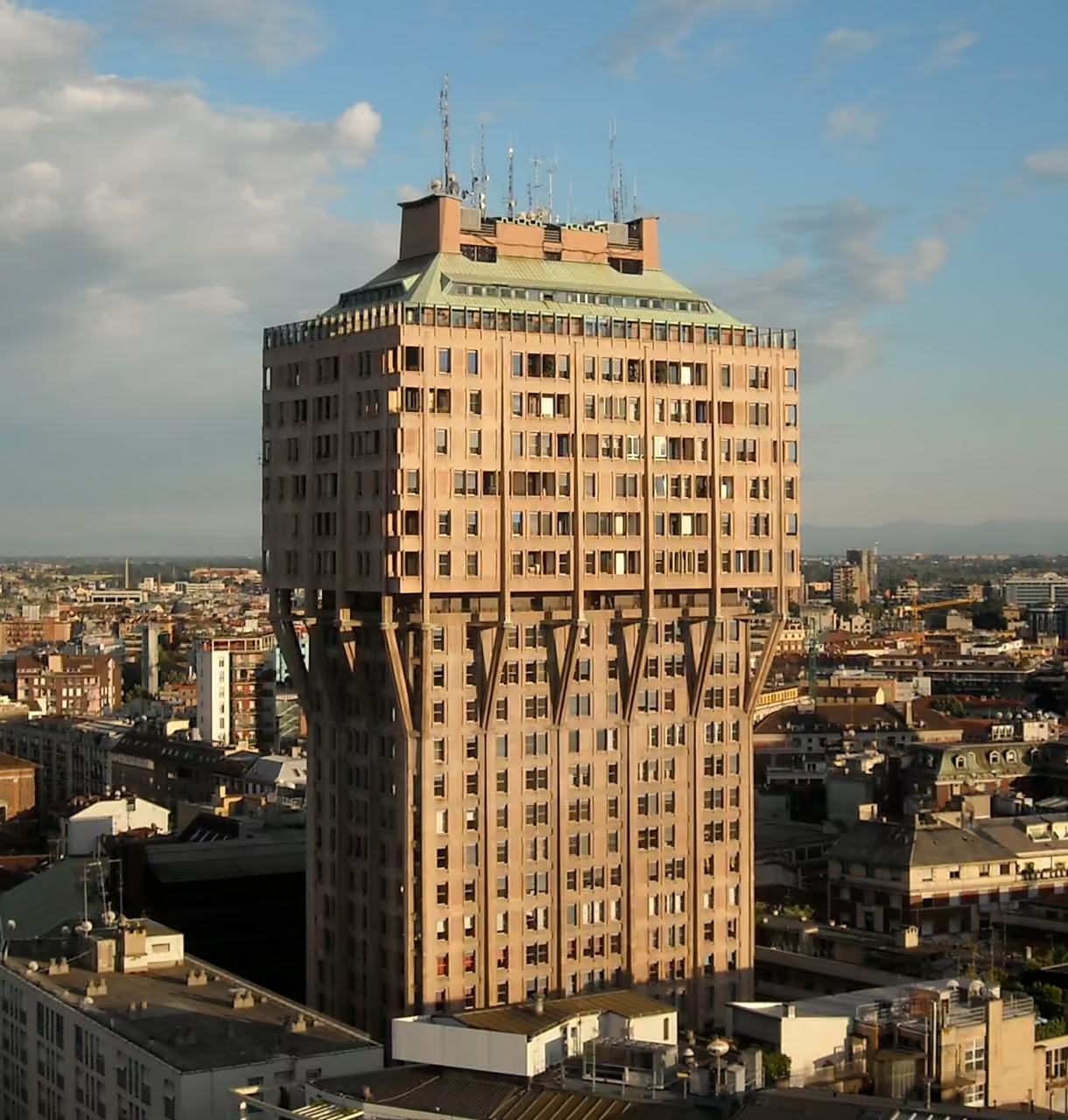
Until 1954 the Duomo was the tallest building in Milan, when the Torre Breda overtook it.
FULL PLACE DETAILS
Updated
FULL PLACE DETAILS
UpdatedOVERVIEW & STATS
- Established
- In 1386, making it 640 years old
- Annual Visitors
- 2,140,786 (2022)
ARCHITECTURE & HERITAGE
- Heritage Status
- Italian National Heritage
- Architectural Styles
- FlamboyantItalian Gothic
- Architects
- Simone Da Orsenigo
WEB & AMENITIES
Milan Cathedral Map & Neighborhood Explorer
This interactive map is centered on Milan Cathedral. Zoom in and move the map around to automatically discover Wikipedia photos and summaries of other nearby sights, monuments, and historical points of interest and stories in real-time!
Milan Cathedral FAQ
Entry to the interior is generally ticketed, with options that add the roof terraces, the baptistery remains and the museum. Check the official Duomo website for current ticket types and book ahead in busy seasons.
A lift in the buttress at the east end of the north transept arm takes visitors up to the terraces, and a staircase route is generally offered as well. Which one you can use depends on the ticket you choose.
Yes, because it is an active place of worship. Shoulders and knees should be covered, so carry a light scarf or a layer in summer.
It is the largest church in Italy, as Saint Peter's Basilica, though bigger, lies in Vatican City. With about 11,700 square metres of interior space, it ranks sixth among the world's largest churches by interior area.
The Madonnina is a gilded copper statue of the Virgin, 4.16 metres tall, unveiled on 30 December 1774 on top of the main spire, 108.5 metres above the ground. It became the symbol of Milan.
They are a cycle of fifty six large canvases from the seventeenth century telling the life and miracles of Saint Charles Borromeo, the most important Baroque painting cycle in Lombardy. They are displayed inside the Duomo in November, around his feast on 4 November.
It is a sundial built in 1786 by astronomers from the Brera observatory. At solar noon a ray of light from a hole high in the south wall lands on the brass strip, near marble slabs marking the zodiac signs.
Work began in 1386 and continued for centuries, with changes of architect, shifting styles and long arguments over the façade. The last bronze door was only added in 1965, and maintenance has never really ended.
A typical visit takes about 3 hours. We recommend planning your schedule accordingly to make the most of your time there.
The closest place to visit near Milan Cathedral is Museum of the 20th Century, around 21 m away. Other things to do near Milan Cathedral include Royal Palace (74 m), Ambrosian Carnival (87 m) and Raise a Campari at Camparino in Galleria (156 m). All of these are within roughly 156 m of Milan Cathedral, close enough to walk.
Milan Cathedral holds the following heritage designation: Italian National Heritage.
It dates back to 1386, making it 640 years old.
Milan Cathedral was designed by Simone da Orsenigo in the Flamboyant style.
According to the latest available data (2022), it received approximately 2,140,786 visitors that year.
While we strive to keep this information accurate and up to date, we recommend verifying any details independently before making decisions based on them.
Places near Milan Cathedral
Make the most of your trip. Check out these top-rated spots located nearby.
 21m
Museum of the 20th Century
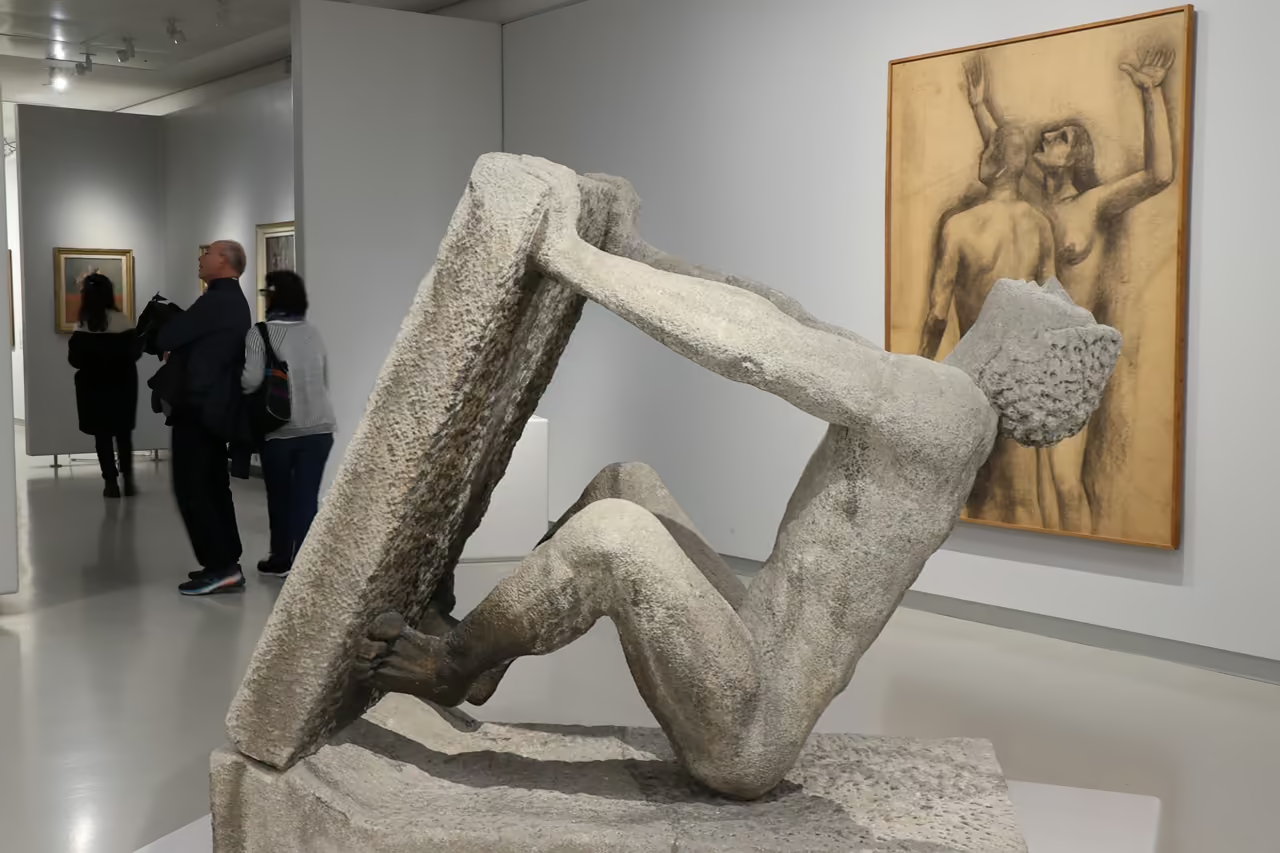
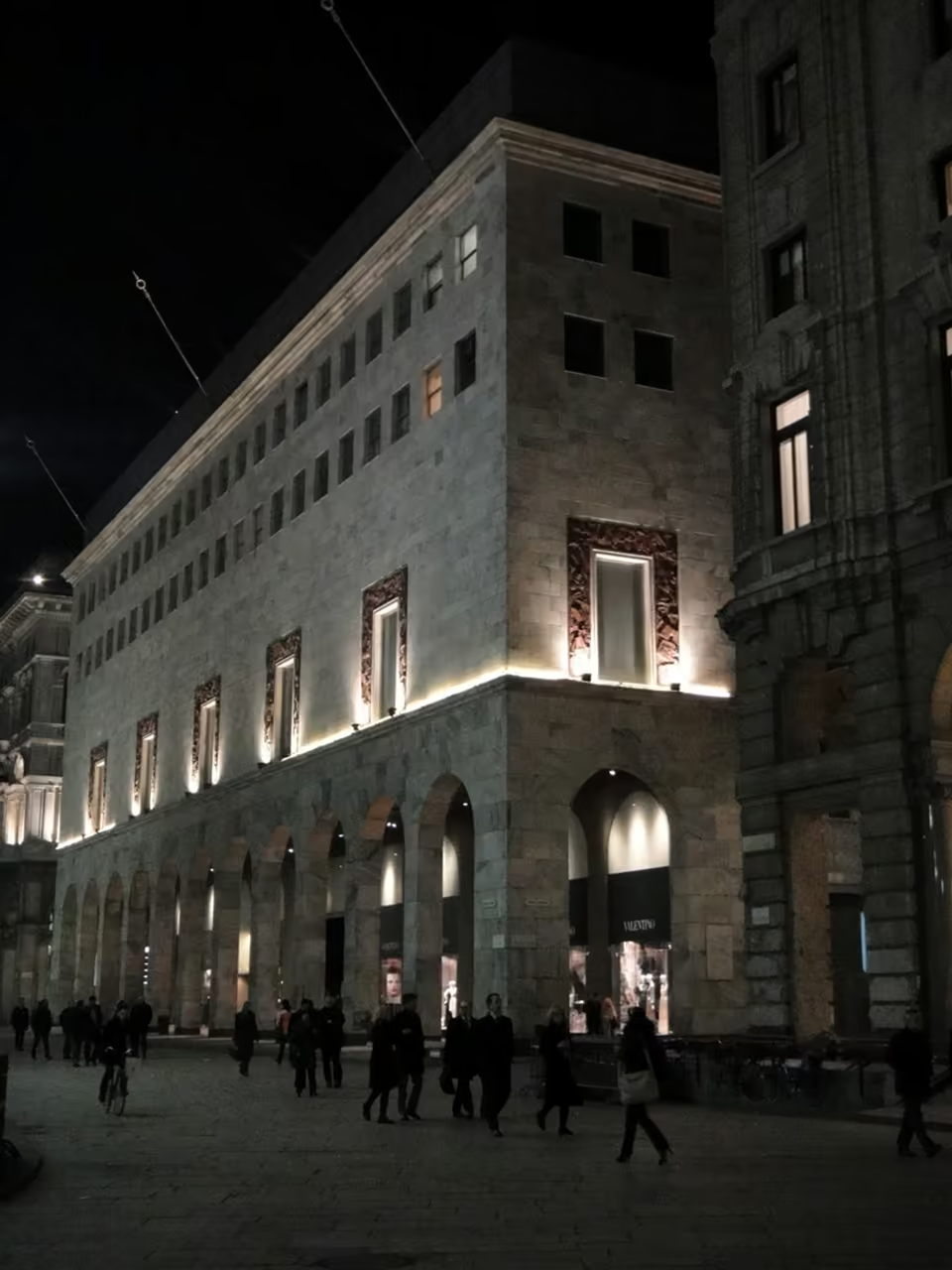
Occupying a heavy fascist-era building overlooking the main square, this collection focuses strictly on 20th-century art. A spiral ramp leads visitors through chronological displays of Futurism, Spatialism, and Arte Povera. The stark, minimalist interiors deliberately contrast with the elaborate Gothic spikes visible through the massive glass windows. Pellizza da Volpedo's colossal painting 'The Fourth Estate' commands the entrance hall.
highlight view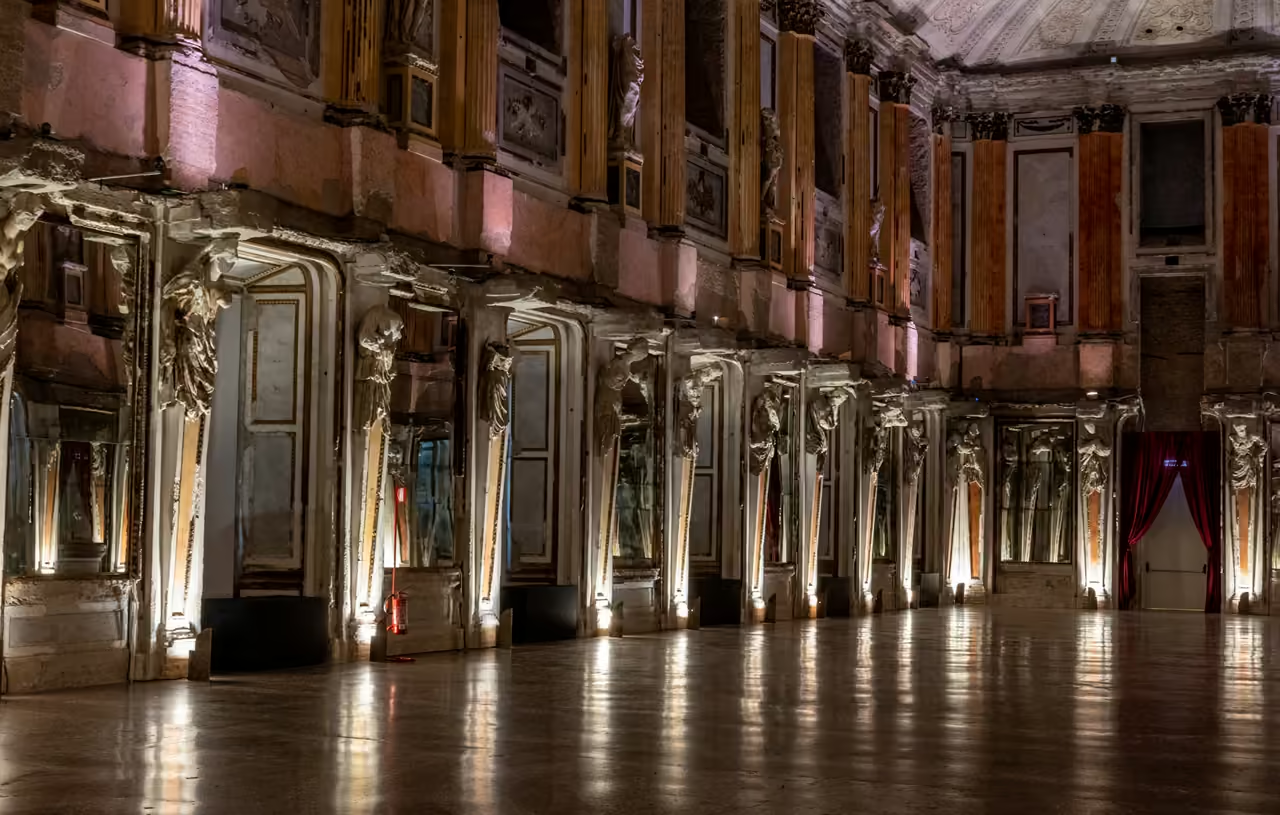 74m
Royal Palace
Severe neoclassical facades wrap around large courtyards directly south of the cathedral. Long serving as the seat of government, the sprawling complex now functions as the premier venue for blockbuster art exhibitions. Hallways that once hosted Austrian governors and Napoleon Bonaparte now display heavily curated collections of international artists. The sweeping central staircase retains a palpable sense of bureaucratic authority and aristocratic weight.
highlight view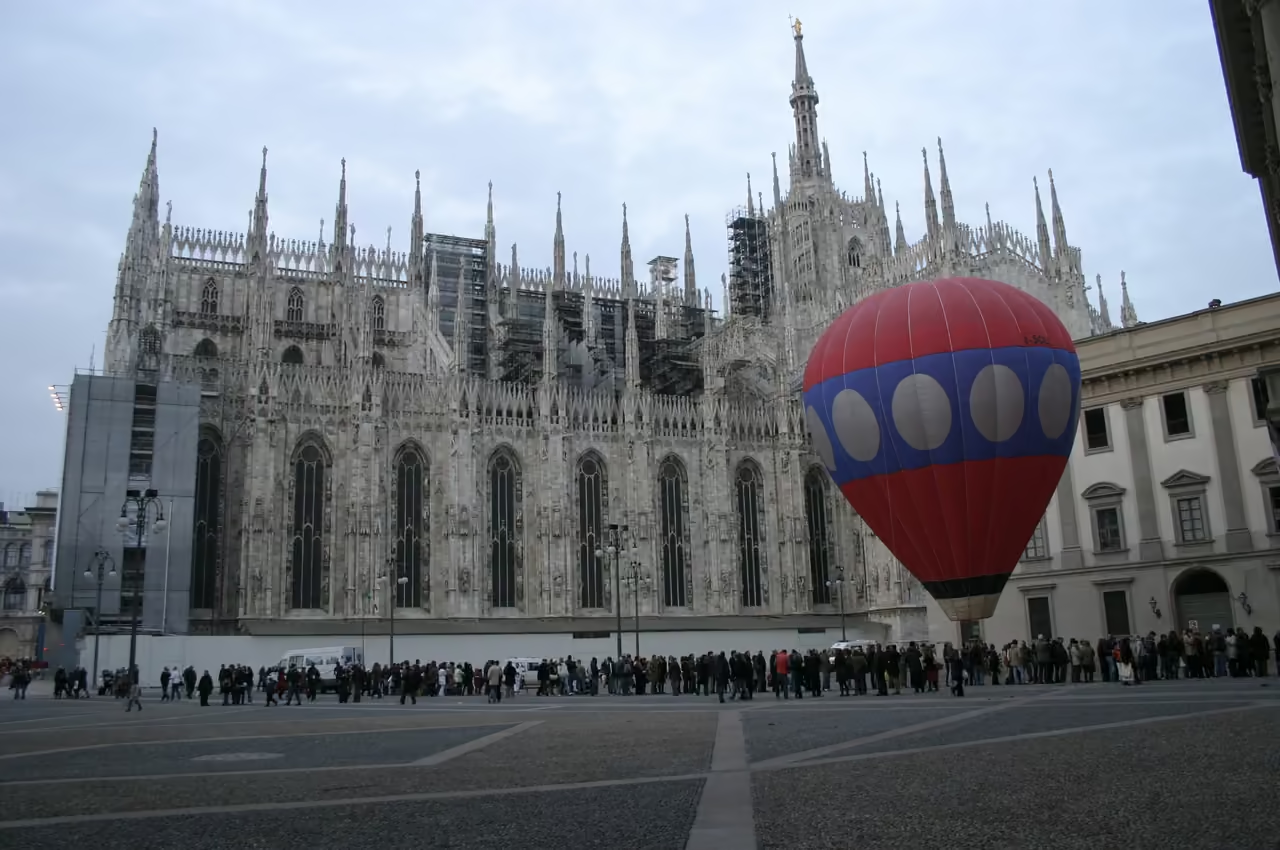 87m
Ambrosian Carnival
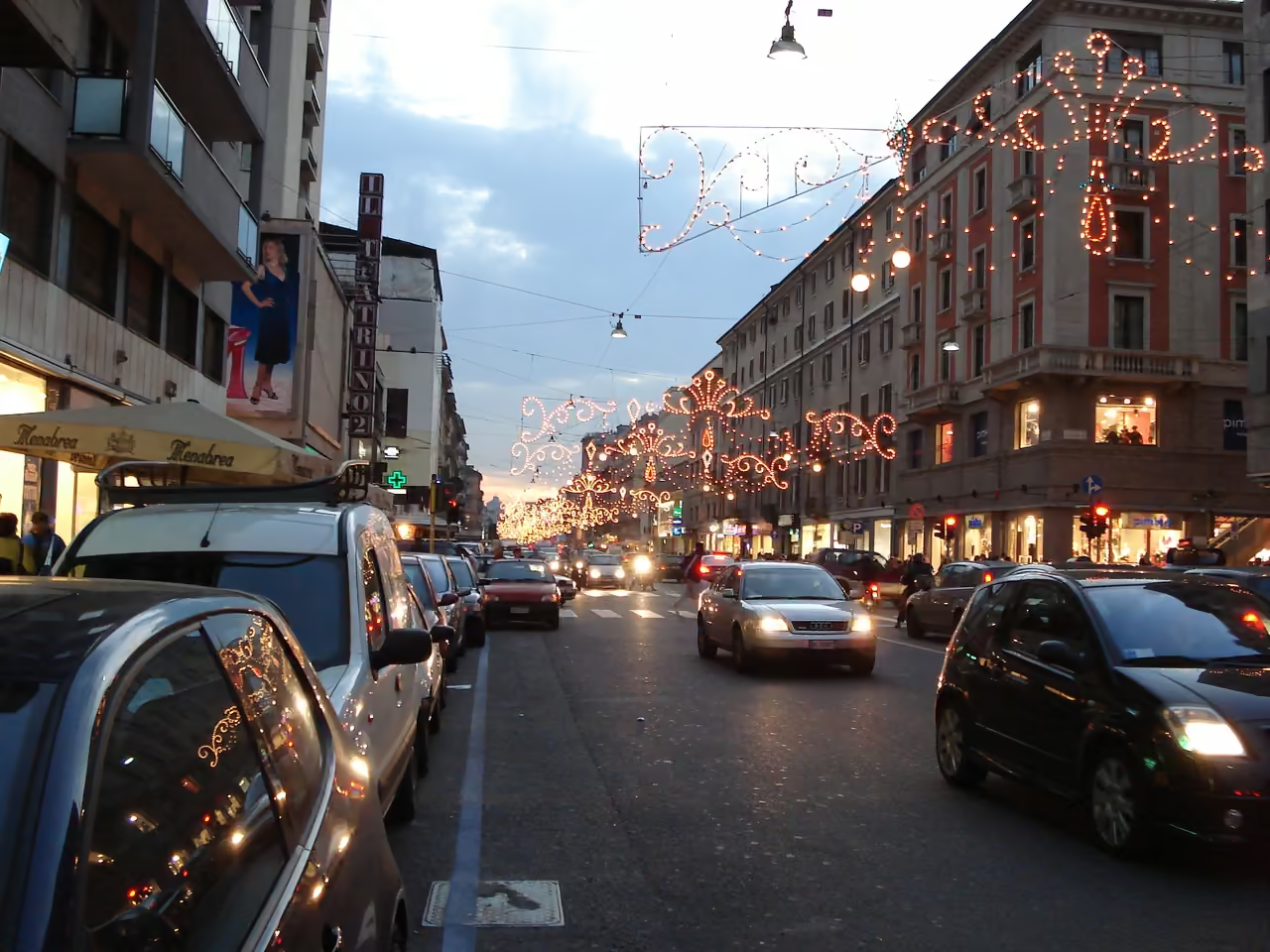
Milan's carnival runs on its own calendar, ending the Saturday after Ash Wednesday rather than on Shrove Tuesday, a quirk of the Ambrosian rite. Children dress up and the local masks Meneghino and Cecca lead processions. Frittelle and chiacchiere, fried pastry dusted with sugar, appear in every bakery.
festival view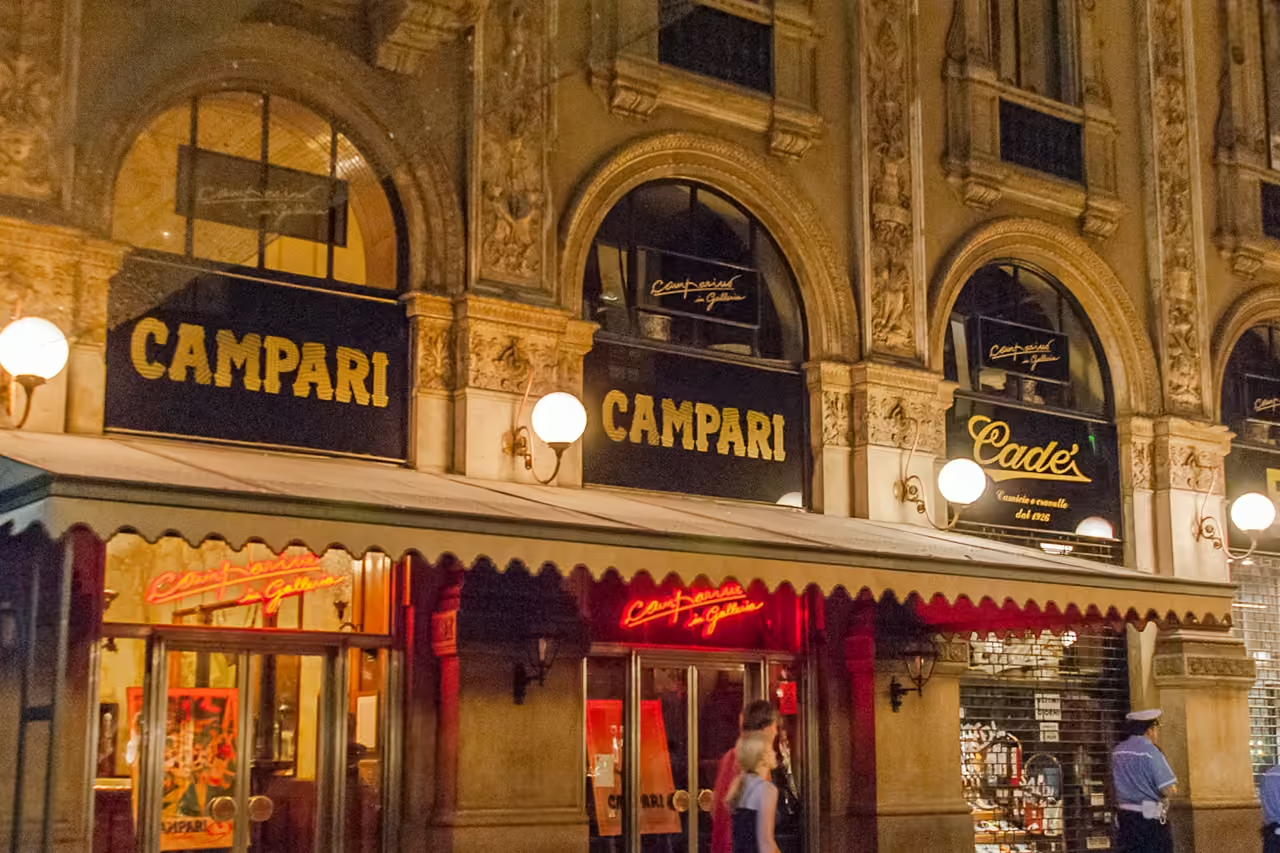 156m
Raise a Campari at Camparino in Galleria
Campari was born in Milan's bar culture, and this historic cocktail bar at the corner of the Galleria is where the ritual still feels theatrical. Bartenders in white jackets pour spritzes and Negronis under a ceiling of Liberty decoration while the cathedral glows through the glass. The drinks cost more than at the Navigli, and the view of the Duomo is part of the price.
highlight view
Explore Similar Places in These Collections
Featured on These Itineraries
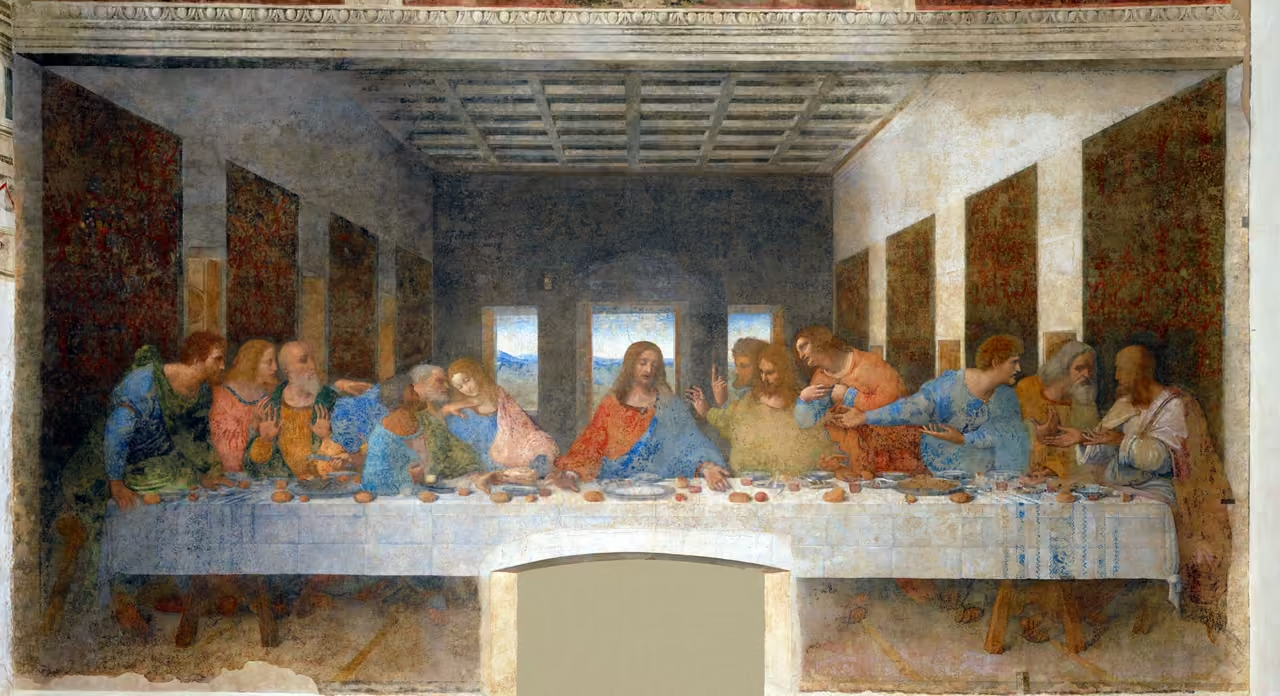
1 Day in Milan
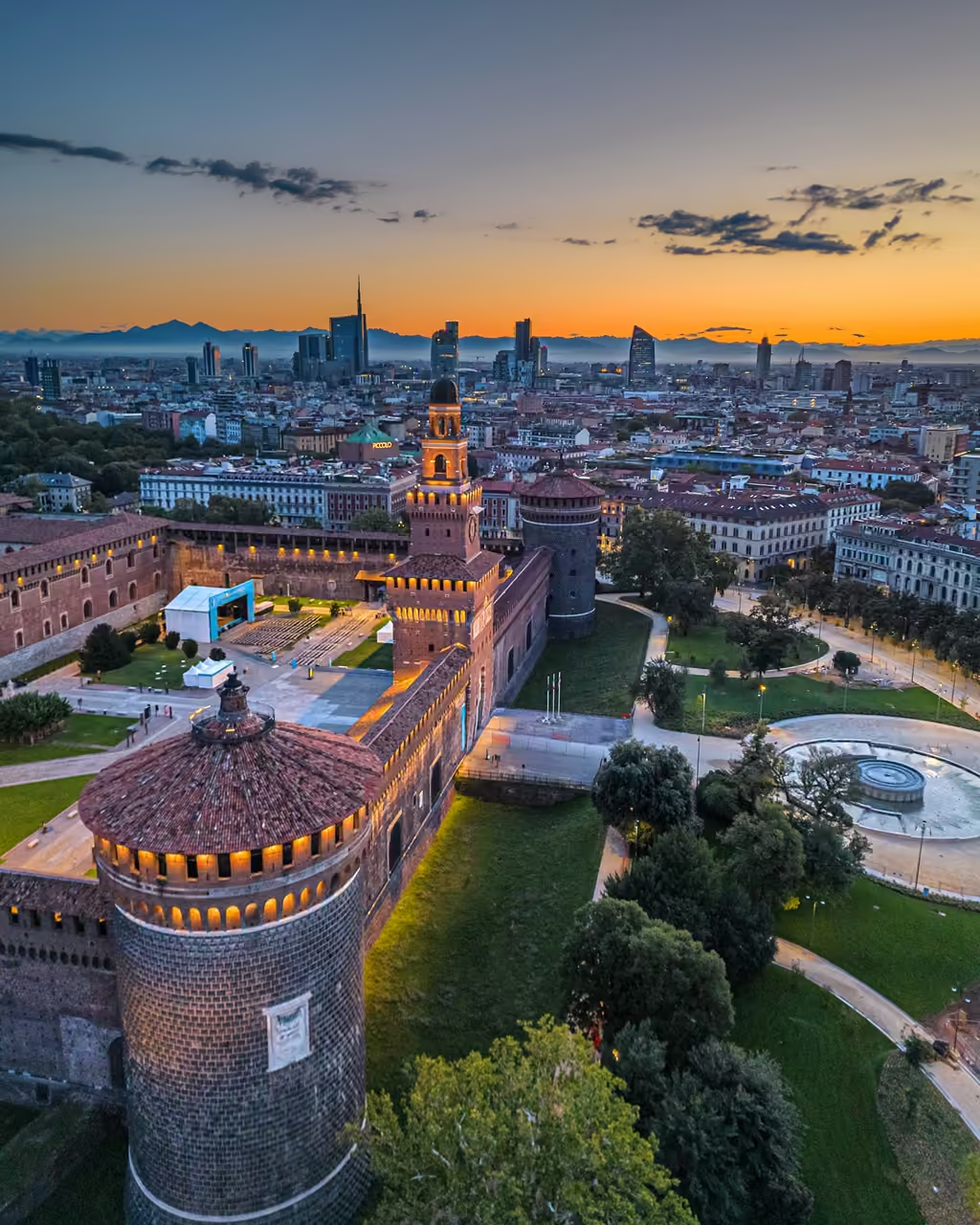
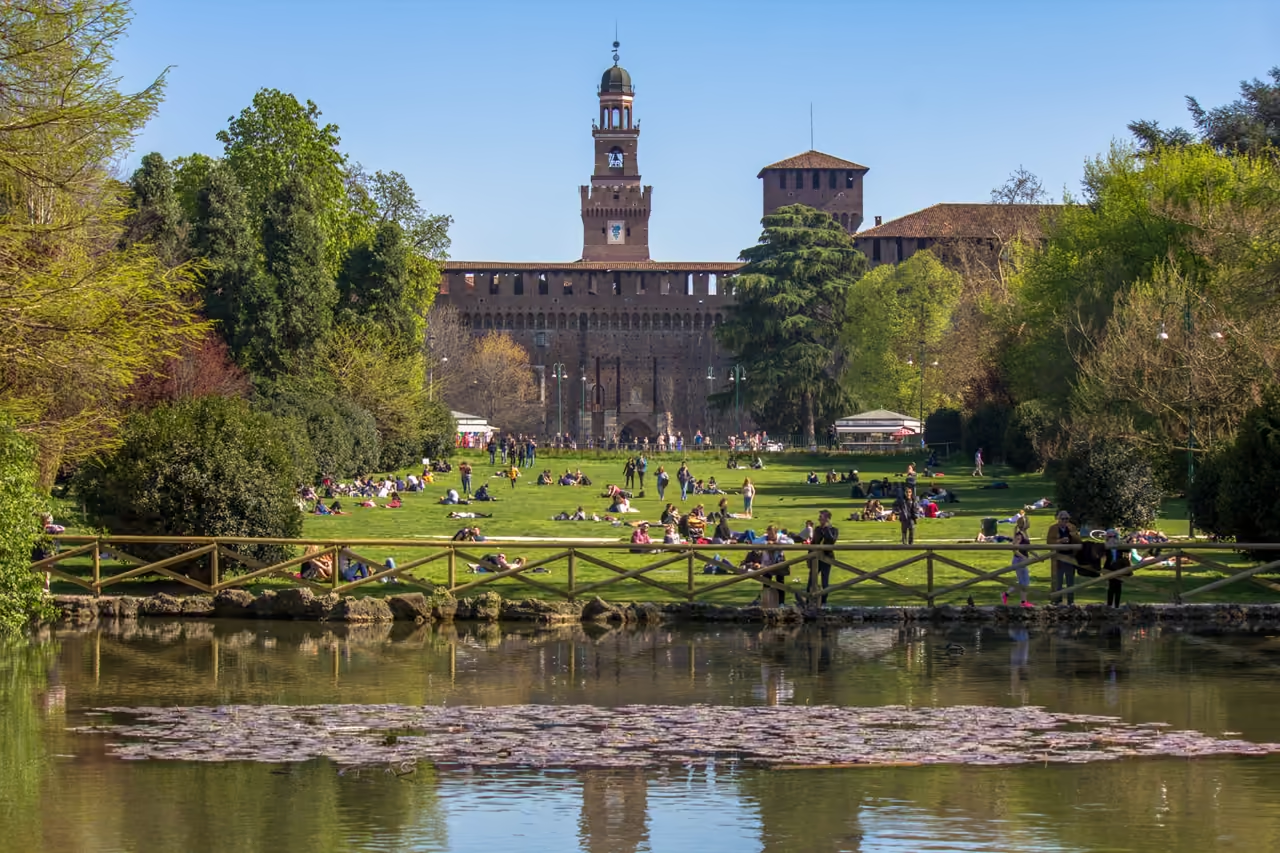
A single day that links Leonardo's masterpiece, a castle, a park, the cathedral and an evening on the canals. Book The Last Supper for the morning and the rest falls into place.
view itinerary
3 Days in Milan
Three days that take in the cathedral district, Leonardo and the castle, and the churches and canals of the south. The pace allows for long lunches and an aperitivo each evening.
view itinerary
5 Days in Milan
Five days that cover the classic sights, Leonardo and the Ambrosian churches, fashion and parks, the canals, and a day among the abbeys and towers outside the centre.
view itinerary
See all attractions in Milan
Including Galleria Vittorio Emanuele II, Sforza Castle, Basilica of Sant'Ambrogio, and more