Hidden Gems & Local Secrets in Biarritz

Step off the tourist trail and experience the authentic side of the city. We've bypassed the crowded landmarks to uncover the best-kept local secrets—from quiet neighborhood courtyards to underground art scenes. Dive into the forgotten histories and unique stories that make these spots truly special.

  • Fishermen's Cabins

    LES CRAMPOTTES
    45 M

    Tiny, rustic huts built directly into the cliff face at the Port des Pêcheurs, featuring brightly painted doors in red, green, and blue. The town strictly regulates ownership, ensuring they remain in the hands of actual boat owners rather than being sold off as luxury holiday rentals. Piles of netting, rusted anchors, and buoys litter the concrete walkways outside. The contrast between these rough, practical workspaces and the opulent mansions hovering a hundred feet above is jarring. Listen to the older fishermen arguing loudly in a mix of French and Basque while they mend their gear. It feels like a completely independent village.

    HISTORY & HIGHLIGHTS

    The small Port des Pêcheurs did not exist until Emperor Napoleon III ordered its construction in the 1850s, hoping to create a viable commercial harbour. The town's fishermen needed somewhere to store their heavy canvas sails, ropes, and traps out of the corrosive salt wind. They carved small, shallow caves directly into the soft limestone cliffs, bricking up the fronts to create the 'crampottes'. When the commercial port failed to materialise due to the sheer violence of the local waves, the fishermen kept the tiny cabins. In 1870, the municipality tried to heavily tax the huts, leading to a fierce standoff with the mariners, who argued they literally built them by hand out of solid rock. The town eventually conceded, and a strict system was put in place dictating that the cabins could never be sold, only passed down to registered boat owners. Today, they form a fiercely guarded, working-class enclave entirely immune to the hyper-gentrification of the cliffs above.
    events spanning 127 years

    YEAR 1858

    Imperial Construction

    Napoleon III orders the construction of a breakwater to protect a new commercial port. The fishermen take advantage of the works to carve storage caves into the cliff face.

    YEAR 1870

    The Tax Standoff

    The town council attempts to levy heavy property taxes on the small cabins. The fishermen revolt, leading to a permanent agreement protecting the structures for maritime use only.

    YEAR 1985

    Protective Decrees

    The municipality institutes strict laws preventing the cabins from being sold on the open market. Only residents who own and operate a boat moored in the port can hold a lease.

    LOCATION

    Loading map...
  • Saint Martin Church

    ÉGLISE SAINT-MARTIN
    30 M

    Hidden inland away from the coastal glitz, this is the oldest standing structure in the town. Built before 1450 and restored in 1541, it represents the original, deeply religious, agricultural heart of the settlement. The stark, heavy Gothic architecture contrasts wildly with the fussy, imported styles of the later royal buildings. Look closely at the bell tower; it used to be whitewashed every single year to serve as a vital navigation marker for fishermen out at sea. Step inside to see the incredible, historically listed wooden stalls.

    HISTORY & HIGHLIGHTS

    Centuries before Napoleon III arrived, Biarritz was not a single town, but a fragmented collection of two distinct communities. The fishermen huddled down by the coast, while the farmers worked the harsh, sandy soil inland around the parish of Saint-Martin. This heavy stone church acted as the absolute centre of power for the agricultural class. Under the Ancien Régime, the 'jurat' (mayor) and the local council held their loud, often combative political meetings directly inside the nave. The building was heavily restored in 1541, introducing stark Gothic elements that survive today. Crucially, the tall, flat front of the bell tower served a dual purpose; the town relentlessly whitewashed it every year so it stood out against the green hills. Whalers fighting storms out in the Bay of Biscay relied on that bright white square to navigate back to the safety of the port. As the town expanded towards the coast in the 19th century, the old church was largely forgotten by the visiting aristocracy, preserving its solemn, ancient atmosphere.

    events spanning 357 years

    YEAR 1541

    Gothic Restoration

    The original medieval structure undergoes a massive restoration. Heavy, imposing Gothic architectural elements are introduced, cementing its status as the town's primary building.

    YEAR 1650

    The Navigation Marker

    The town council orders the bell tower to be painted bright white annually. It becomes the primary visual reference point for whalers returning from deep sea hunts.

    YEAR 1898

    Loss of Primacy

    The construction of the Sainte-Eugénie church down by the coast shifts the religious focus of the town. Saint-Martin is left to the locals, escaping the heavy ornamentation of the Belle Époque.

    LOCATION

    Loading map...

    FULL PLACE DETAILS

    Updated

    ARCHITECTURE & HERITAGE

    Heritage Status
    Monument Historique Inscrit
  • Atlantic Wall Embrasures

    LES EMBRASURES DU MUR DE L'ATLANTIQUE
    30 M

    Gun slits open in the rock beneath ordinary villas along the Boulevard du Prince de Galles. They belong to a defensive complex dug into the cliffs during the occupation of the 1940s. Visible from the road and the cliff path, they are a sobering counterpoint to the seafront's grand hotels.

    HISTORY & HIGHLIGHTS

    When German troops occupied the Basque coast on 27 June 1940, the cliffs of Biarritz were soon folded into the Atlantic Wall. The navy arrived in early July, and engineers working with the Organisation Todt, whose offices sat in the Hôtel Régina, began cutting defensive positions into the rock. By the end of 1942 a naval artillery commander, Lieutenant Commander Ludwig, had planned a command post beneath the Atalaye plateau, coded BA 39 40, and he stayed there until the Liberation. Further north, position BA 34 was driven into the Pointe Saint-Martin beneath a villa on what is now Avenue du Général Mac Crosky, while BA 41 opened its embrasures along the Boulevard du Prince de Galles. Allied aircraft bombed the town on 27 March 1944. After the war the same seafront, renamed and tidied, welcomed American students, which gives the shoreline its odd layering: slits in the rock, then palace hotels, then surf schools.

    events spanning 5 years

    YEAR 1940

    The Cliffs Become a Fortress

    German troops occupy the Basque coast on 27 June 1940, and the navy arrives in early July. Defensive positions begin to be cut into the cliffs of Biarritz.

    YEAR 1942

    A Command Post Beneath the Atalaye

    Late in 1942 Lieutenant Commander Ludwig and the Organisation Todt plan the command post coded BA 39 40 on the Atalaye plateau.

    YEAR 1944

    Bombers over the Town

    On 27 March 1944 Allied aircraft bomb Biarritz while heading for the airfield at Parme.

    YEAR 1945

    Students Replace Soldiers

    The American University of Biarritz opens in August 1945 for soldiers waiting to return home, bringing a very different kind of occupation to the seafront.

    LOCATION

    Loading map...
  • Round Rock

    LA ROCHE RONDE
    20 M

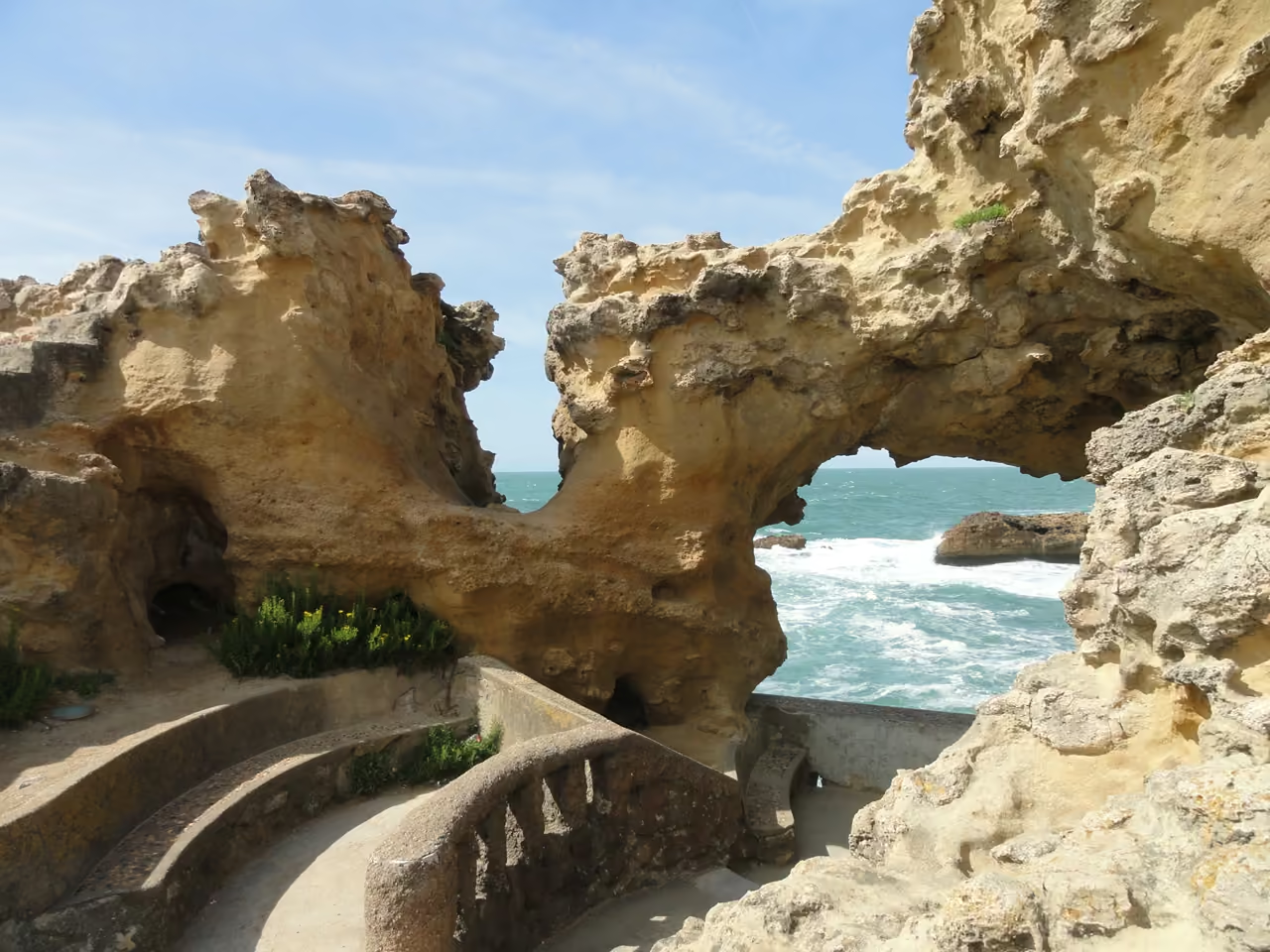
    A massive, perforated stone pillar erupting from the ocean just offshore from the Miramar beach. The constant, brutal action of the Atlantic waves has bored a large hole directly through the centre of the rock. It functions as a heavily protected Natura 2000 sanctuary, acting as a crucial nesting ground for European storm petrels and yellow-legged gulls. You cannot walk out to it, but you can stand on the sand and watch the birds dive aggressively into the water. When a heavy winter swell rolls in, the waves explode through the central hole like a geyser.

    HISTORY & HIGHLIGHTS

    For millions of years, the coastal limestone cliffs extended much further out into the Bay of Biscay. The relentless, hammering force of the Atlantic waves systematically dismantled the coastline, leaving only the hardest, most resilient pillars of rock standing isolated in the surf. The Roche Ronde survived due to its specific geological density, though the ocean managed to punch a hole straight through its centre. Throughout the 19th century, wealthy tourists would hire local fishermen to row them out to the rock in small skiffs, an incredibly dangerous practice that often ended in capsized boats. As the town modernised, ecologists realised the isolated rock was a vital, predator-free sanctuary for sea birds. The government designated it a Natura 2000 site in 2006, formally recognising its role as an ecological fortress. The relentless erosion continues, and local geologists know that eventually, the ocean will collapse the arch entirely.

    events spanning 7006 years

    YEAR -5000

    The Geological Fracture

    The softer surrounding limestone completely erodes away, leaving the dense rock pillar isolated in the bay. The constant wave action begins carving the central arch.

    YEAR 1880

    Tourist Excursions

    Aristocratic holidaymakers pay fishermen to row them perilously close to the rock. The dangerous practice is eventually abandoned due to the heavy, unpredictable surf.

    YEAR 2006

    Ecological Protection

    The French government officially classifies the rock as a Natura 2000 protected site. It becomes a dedicated, undisturbed sanctuary for nesting sea birds.

    LOCATION

    Loading map...
  • Synagogue of Biarritz

    SYNAGOGUE DE BIARRITZ
    20 M

    Built in 1904 on former imperial land, the synagogue stands on Rue Pellot, a short walk from the town centre. It tells the story of the Jewish families who joined the Belle Époque crowds and of the older community of nearby Bayonne. Services are held in July and August, when the summer congregation returns.

    HISTORY & HIGHLIGHTS

    Bayonne's Jewish history reaches back to 1492, when the Alhambra Decree drove Jews out of Spain and many found refuge across the Adour. Biarritz had no place of worship of its own until the Second Empire turned it into a resort that drew Europe's aristocracy and wealthy families, among them the Poliakov brothers, financiers and railway magnates ennobled by the tsar. The synagogue went up on former imperial land at the initiative of the Pereire brothers and Lazare Poliakov, and it was inaugurated on 7 September 1904. Services were divided so that half followed the Ashkenazi rite for visitors from abroad and half the Portuguese rite of Bayonne's own community. It reopened in 2012 and holds services in July and August.

    events spanning 520 years

    YEAR 1492

    Refuge Across the Adour

    After the Alhambra Decree of 1492, Jews fleeing Spain and Portugal find refuge in Bayonne, laying the roots of the region's Jewish community.

    YEAR 1904

    The Synagogue Is Inaugurated

    On 7 September 1904 the synagogue opens on former imperial land, funded through the Pereire brothers and Lazare Poliakov.

    YEAR 2012

    The Doors Reopen

    After a period of closure, the synagogue reopens in 2012, with services held in July and August.

    LOCATION

    Loading map...

    FULL PLACE DETAILS

    Updated

    OVERVIEW & STATS

    Established
    In 1904, making it 122 years old
  • Wave Energy Laboratory Ruins

    RUINES DU LABORATOIRE HYDRODYNAMIQUE
    20 M

    At the foot of the lighthouse, weathered walls and rusted frames mark the site of a pioneering experiment. In 1929 an engineer tried to harness the energy of the Atlantic waves here, and the project was cut short by the economic crash. Few visitors notice the ruins as they head for the lighthouse stairs.

    LOCATION

    Loading map...

    FULL PLACE DETAILS

    Updated

    OVERVIEW & STATS

    Established
    In 1834, making it 192 years old
    Annual Visitors
    17,223

    ARCHITECTURE & HERITAGE

    Heritage Status
    Monument Historique Inscrit
KEEP EXPLORING

More to see in Biarritz