Hidden Gems & Local Secrets in Vatican City

Step off the tourist trail and experience the authentic side of the city. We've bypassed the crowded landmarks to uncover the best-kept local secrets—from quiet neighborhood courtyards to underground art scenes. Dive into the forgotten histories and unique stories that make these spots truly special.

  • Vatican Necropolis

    SCAVI VATICANI
    1 H 30 M

    Hidden deep beneath the polished marble floors of the modern basilica lies a remarkably preserved ancient Roman street of the dead. This dark, humid archaeological site features incredibly intricate pagan mausoleums and early Christian tombs, slowly ascending toward the site's most sacred point. The tour culminates at a humble, glass-encased niche containing bones verified by the Vatican to belong to Saint Peter himself. Access is strictly limited to around 250 people a day to preserve the delicate environment, requiring written requests months in advance. It is an intensely atmospheric, chilling, and profoundly historic journey back to the first century.

    HISTORY & HIGHLIGHTS

    Before there was a grand basilica, or even a small church, the Vatican hill was a marshy slope outside the city walls where Romans buried their dead. Wealthy pagan families constructed elaborate, beautifully decorated mausoleums here, creating a literal city of the dead that crept up the hillside. In 64 AD, following a brutal execution in the nearby Circus of Nero, the body of an obscure fisherman from Galilee named Peter was hastily buried in a shallow, simple grave among these grandiose pagan monuments. For nearly three centuries, this humble dirt grave was secretly venerated by the persecuted Christian community, who built a small red wall to mark the spot. When Emperor Constantine the Great legalised Christianity, he ordered the ambitious construction of a massive basilica. To do so, his engineers performed a monumental feat: they sliced the top off the Vatican hill, filling in the ancient pagan street with tons of dirt to create a level platform, perfectly centering the new altar directly over Peter's grave. The ancient necropolis was entombed in darkness and completely forgotten for over a thousand years. In the 1940s, Pope Pius XII ordered secret excavations beneath the modern basilica to create more space for papal tombs. Archaeologists were stunned to break through walls and discover the perfectly preserved ancient street of mausoleums. As they painstakingly dug further, they uncovered the ancient red wall, ancient graffiti proclaiming 'Peter is here', and eventually, a hidden repository containing bones draped in purple and gold fabric. This monumental discovery firmly anchored the spiritual legend of the Vatican into tangible, archaeological reality.
    events spanning 1904 years

    YEAR 64

    A Humble Burial

    Following his crucifixion in the Circus of Nero, the apostle Peter is buried in a simple dirt grave on the sloping Vatican hill.

    YEAR 326

    Entombing the City of the Dead

    Constantine's engineers bury the entire pagan necropolis under thousands of tons of earth to build a level platform for Old St. Peter's.

    YEAR 1940

    Secret Excavations Begin

    Pope Pius XII orders secret archaeological digs beneath the grottos, leading to the stunning rediscovery of the ancient Roman street.

    YEAR 1968

    Confirmation of the Relics

    After decades of intense study and analysis, Pope Paul VI publicly announces that the bones of Saint Peter have been conclusively identified.

    LOCATION

    Loading map...
  • Casina Pio IV

    45 M

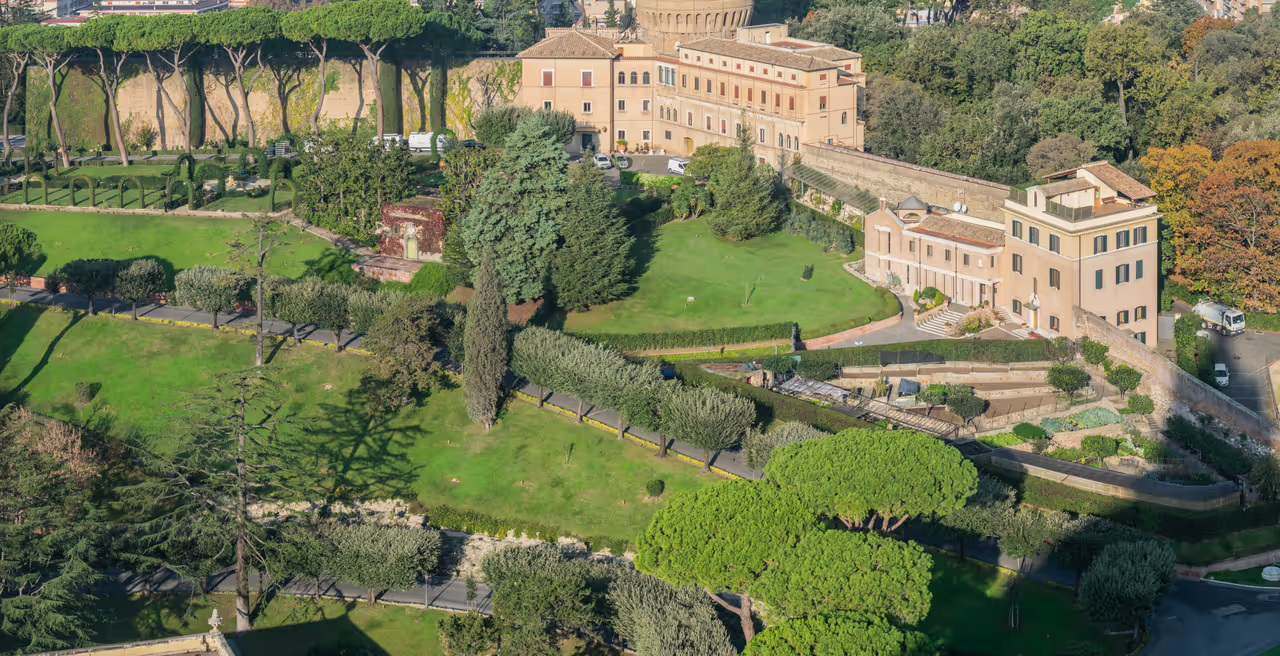
    Hidden deep within the lush greenery of the Vatican Gardens, this exquisite Renaissance villa is a masterpiece of elegant, ornate architecture. Originally built in the 16th century as a summer retreat and hunting lodge for the popes, it features intricate stucco facades, beautiful courtyards, and classical fountains. Today, it serves as the prestigious headquarters for the Pontifical Academy of Sciences, bringing together world-renowned scientists and Nobel laureates within its historic walls. Because it is located in the restricted gardens, it remains blissfully free of typical tourist crowds. It is a stunning architectural gem where ancient art meets modern, cutting-edge scientific discussion.

    HISTORY & HIGHLIGHTS

    In 1558, Pope Paul IV commissioned the architect Pirro Ligorio to design a peaceful, secluded retreat deep within the Vatican Gardens, far from the stifling heat and political pressures of the Apostolic Palace. The project, initially named the Casina del Bosco (Lodge of the Woods), was completed under his successor, Pope Pius IV, who gave the building its current name. Ligorio designed a magnificent, highly ornamented Renaissance villa, covering the exterior walls in complex stucco reliefs depicting classical mythology, muses, and intricate geometric patterns. It served as a private oasis where popes could relax, entertain intimate guests, and escape the rigorous demands of their office. For centuries, the Casina Pio IV remained a quiet, exclusive presidential pavilion. However, in 1936, Pope Pius XI sought to modernise the intellectual standing of the Church by founding the Pontifical Academy of Sciences. He chose the beautiful, secluded Casina as the headquarters for this new institution. The villa was transformed from a luxurious hunting lodge into a serious academic hub, outfitted to host international conferences and intense scientific debates. Today, this Renaissance gem regularly hosts some of the brightest minds on the planet, including numerous Nobel laureates, regardless of their religious affiliation. Legendary figures like Stephen Hawking and Alexander Fleming have walked its ornate courtyards to discuss physics, genetics, and climate change with the Catholic hierarchy. The Casina stands as a beautiful, physical bridge between the deep artistic heritage of the Church and its engagement with modern empirical science.

    events spanning 458 years

    YEAR 1558

    Commissioning a Retreat

    Pope Paul IV hires architect Pirro Ligorio to build a secluded summer lodge within the dense woods of the Vatican Gardens.

    YEAR 1936

    A Home for Science

    Pope Pius XI establishes the Pontifical Academy of Sciences and designates the stunning Renaissance villa as its permanent headquarters.

    YEAR 2016

    A Gathering of Geniuses

    Stephen Hawking attends an academic conference at the Casina, highlighting the Vatican's commitment to engaging with cutting-edge secular science.

    LOCATION

    Loading map...

    FULL PLACE DETAILS

    OVERVIEW & STATS

    Established
    In 1558, making it 468 years old

    ARCHITECTURE & HERITAGE

    Architectural Styles
    Mannerism
    Architects
    Pirro Ligorio
  • Vatican Post Office

    POSTE VATICANE
    15 M

    Operating directly adjacent to St. Peter's Square, this is the main branch of the Vatican's highly efficient, independent postal service. Founded in 1929, the service is renowned by Romans and tourists alike for outperforming the notorious Italian postal system. The interior is bustling and highly functional, where you can purchase beautiful, limited-edition Vatican stamps that are highly prized by philatelists worldwide. Dropping a postcard into the bright yellow pillar boxes ensures it will be stamped with the unique Vatican postmark. It is a wonderfully interactive, incredibly cheap way to engage with the sovereignty of the microstate.

    HISTORY & HIGHLIGHTS

    Before the 20th century, the expansive Papal States operated their own postal system, but the capture of Rome in 1870 abruptly ended the popes' territorial control. For decades, the isolated pontiffs had to rely awkwardly on the postal service of the newly formed Italian state. This all changed in February 1929 with the signing of the Lateran Treaty, which officially established Vatican City as an independent nation. Almost immediately, the Vatican set to work establishing the hallmarks of sovereignty, and by August of that year, the Poste Vaticane was operational and issuing its very first set of stamps. The Vatican post quickly earned a sterling reputation. Because of the extremely small geographic area it had to cover, and its direct routing agreements with international postal networks, it bypassed the infamous bureaucracy of the surrounding Italian postal service. Romans living near the borders would routinely cross into the Vatican simply to mail important letters, knowing the bright yellow post boxes guaranteed faster, more reliable delivery than the red Italian boxes. Today, the Poste Vaticane is highly modernised but relies heavily on the tourist trade and philatelists. The stamps produced by the Philatelic and Numismatic Office are considered beautiful, miniature works of art, often commemorating papal trips, historical anniversaries, and religious art. Despite the rise of digital communication, the post office processes massive volumes of mail daily, driven by visitors eager to send a physical piece of the world's smallest country back home.

    events spanning 81 years

    YEAR 1929

    Rebirth of the Papal Post

    Following the Lateran Treaty, the Vatican officially re-establishes an independent postal service and issues its first series of postage stamps.

    YEAR 1929

    International Integration

    Vatican City becomes a full member of the Universal Postal Union, allowing its mail to be recognised and delivered globally.

    YEAR 2010

    The Pope's Mail Delivery

    A dedicated mobile post office truck is introduced in St. Peter's Square to handle the massive influx of tourist postcards.

    LOCATION

    Loading map...

    FULL PLACE DETAILS

    OVERVIEW & STATS

    Established
    In 1929, making it 97 years old

    ARCHITECTURE & HERITAGE

    Founders
    Vatican City

    WEB & AMENITIES

  • Vatican Pharmacy

    FARMACIA VATICANA
    30 M

    Tucked away inside the sovereign walls, the Vatican Pharmacy is allegedly the busiest pharmacy in the world, serving thousands of customers daily. It is highly prized by Romans because it stocks specialized international medications and treatments that are otherwise unavailable or incredibly hard to find in Italy. To enter the pharmacy, you must pass through Vatican security with a valid medical prescription, official identification, and obtain a specific temporary pass. It is staffed by a religious order of monks who seamlessly blend modern pharmaceutical science with centuries of healing tradition. It offers a fascinating, practical glimpse into the daily operational life of the microstate.

    HISTORY & HIGHLIGHTS

    The tradition of a papal pharmacy dates back to the early days of the Church, where religious orders were primarily responsible for the medical care of the Pope and the poor. In 1874, during a period of immense political tension when the Pope declared himself a 'prisoner in the Vatican', Eusebio Ludvig Fronmen, a monk of the Fatebenefratelli order, was tasked with establishing a formal, modern pharmacy within the walls. The goal was to ensure that the Pope and the isolated papal court had access to essential medicines without needing to rely on the hostile Italian government outside the gates. Over the decades, the pharmacy evolved from a small internal dispensary into an incredibly sophisticated, internationally connected operation. Because the Vatican is an independent sovereign state, its pharmacy is not subject to the slow, bureaucratic approval processes of the Italian health system or the European Union. This unique legal loophole allowed the Vatican Pharmacy to quickly import cutting-edge drugs, rare international medications, and experimental treatments that were completely unavailable to the general public in Rome. Today, the pharmacy remains under the direction of the Fatebenefratelli monks, though it employs highly trained lay pharmacists. It processes thousands of prescriptions daily, acting as a crucial medical lifeline for many Romans suffering from rare conditions. While it operates as a highly modern facility, it firmly adheres to Catholic doctrine, meaning you will never find contraceptives or certain other controversial medical products on its shelves.

    events spanning 146 years

    YEAR 1874

    A Monk's Mission

    Brother Eusebio Ludvig Fronmen officially establishes the Vatican Pharmacy to provide medical independence for the isolated papal court.

    YEAR 1929

    Moving Operations

    The pharmacy is moved to a dedicated facility within the Palazzo Belvedere to accommodate the growing need for international medical imports.

    YEAR 2020

    Modernisation and Expansion

    The facility undergoes massive renovations, introducing automated robotic dispensing systems while still maintaining the direction of the monastic order.

    LOCATION

    Loading map...

    FULL PLACE DETAILS

    OVERVIEW & STATS

    Established
    In 1874, making it 152 years old

    WEB & AMENITIES

  • Vatican Railway Station

    STAZIONE FERROVIARIA VATICANA
    20 M

    Holding the quirky title of the shortest national railway network in the world, this small, elegant station features a mere 300 metres of track. Built following the Lateran Treaty, the station is a beautiful example of the austere, monumental architecture of the 1930s, featuring rich marble interiors. Originally intended to host grand arrivals of international monarchs and dignitaries, it is now used primarily for transporting freight and occasional luxury tourist trains. Tucked quietly behind St. Peter's Basilica, its peaceful, almost abandoned atmosphere is a stark contrast to the chaotic streets of Rome. Visiting the station offers a wonderful, peculiar slice of the microstate's sovereign infrastructure.

    HISTORY & HIGHLIGHTS

    When the Lateran Treaty of 1929 established the Vatican as an independent sovereign state, it necessitated the creation of modern national infrastructure, including a railway connection. The Italian government, as part of the treaty, agreed to construct a brief spur line branching off from the Rome-San Pietro station, cutting directly through the ancient defensive walls into the Pope's territory. The station building itself was designed by the architect Giuseppe Momo, featuring a lavish, marble-clad interior intended to impress visiting heads of state and royalty arriving to meet the Pontiff. Despite the grand architectural ambitions and the beautiful design of the station, it rarely saw the prestigious passenger traffic it was built for. Pope Pius XI, who oversaw its construction, never actually used the railway himself. It wasn't until 1962 that Pope John XXIII became the first pontiff to depart from the station, taking a historic train journey to Assisi. For most of its existence, the quiet, 300-metre track was utilised simply to discreetly import freight, goods, and supplies into the tax-free haven of the Vatican. In recent years, the station has seen a minor renaissance as a passenger hub, albeit for a very specific purpose. In 2015, the Vatican initiated a special weekly tourist train, allowing visitors to board at the Vatican station and travel directly to the Pope's summer residence at Castel Gandolfo. The station remains a beautiful, peculiar monument to the complex negotiations and nation-building of the 1920s.

    events spanning 86 years

    YEAR 1929

    Treaty Mandates a Train

    The Lateran Treaty is signed, legally obligating the Italian government to construct a railway connecting the new microstate to the Italian network.

    YEAR 1962

    The First Papal Journey

    Pope John XXIII makes history as the first pontiff to actively use the station, departing on a pilgrimage train to Loreto and Assisi.

    YEAR 2015

    Opening to the Public

    The Vatican inaugurates a weekly tourist train service, allowing the public to finally utilize the historic station for trips to Castel Gandolfo.

    LOCATION

    Loading map...

    FULL PLACE DETAILS

    OVERVIEW & STATS

    Established
    In 1934, making it 92 years old
    Elevation
    38 m

    ARCHITECTURE & HERITAGE

    Architects
    Giuseppe Momo
KEEP EXPLORING

More to see in Vatican City